
Please Choose Your Language
Views: 0 Author: Site Editor Publish Time: 2026-06-19 Origin: Site


Scaling a pet treat business requires balancing production demands against equipment capacity. Purchasing the wrong unit size creates immediate operational bottlenecks. It also traps your kitchen in a cycle of inefficient production runs. Transitioning from hobbyist to commercial manufacturing forces a critical choice. You must decide between an agile 8-tray setup and a high-yield 12-tray system. Each option carries distinct advantages depending on your daily output goals.
This guide breaks down batch yields, footprint constraints, and daily operational realities. We examine how different capacities directly impact prep time and labor efficiency. You will learn how to evaluate your target volume against raw ingredient shrinkage rates. By understanding these key production variables, you can select equipment perfectly aligned to your growth trajectory.
Throughput rules the decision: A 12-tray unit offers 50% more drying area per cycle, fundamentally lowering the labor-cost-per-treat ratio.
Material matters for compliance: Commercial pet treats demand strict sanitation, making a Stainless Steel Digital Food Dehydrator non-negotiable for adhering to local agricultural and safety regulations.
Space vs. Yield: 8-tray units excel in micro-kitchens and R&D testing (like developing new plant-based chews), while 12-tray units are built for established wholesale fulfillment.
Safety thresholds: Both sizes must sustain internal temperatures of 160°F+ consistently to safely process raw meats into jerky.
Assessing your weekly target yield forms the foundation of smart equipment selection. You cannot accurately gauge your needs based on raw ingredient weight alone. Pet treats experience massive moisture loss during processing. Raw muscle meats lose roughly 60% to 70% of their initial weight. Sweet potatoes and similar fibrous ingredients lose between 50% and 60%.
If you aim to package 20 pounds of chicken jerky weekly, you must process nearly 65 pounds of raw poultry. An undersized unit forces you to run consecutive micro-batches. You must map these raw-to-dry conversion rates against the total square inches of drying area available per cycle.
Active labor hours dictate your overall operational efficiency. Loading a larger unit requires more upfront slicing, marinating, and tray arrangement. However, maximizing tray space drastically reduces your total weekly processing cycles. You spend fewer hours washing trays, resetting timers, and transferring finished products into bulk storage.
Undersizing your Food Dehydrator introduces severe bottleneck realities. Running a smaller unit continuously increases mechanical wear-and-tear. It strains internal heating elements and exhaust fans. Limited capacity also prevents you from building adequate buffer inventory. When an unexpected wholesale order arrives, you lack the reserved stock to fulfill it quickly.
Micro-brands often start their journey using an 8-tray equipment configuration. Solopreneurs find this capacity perfect for localized operations. Farmers' market sellers benefit from the manageable batch sizes. Established companies also deploy these units when introducing experimental product lines without disrupting their primary production schedule.
This compact size presents several distinct strategic advantages. It requires a significantly lower initial capital expenditure. The electrical draw remains manageable for standard commercial kitchen outlets. You can easily place these units on standard prep tables. They do not require reinforced industrial shelving or specialized ventilation hoods.
Many pet bakeries utilize an 8-tray unit as a dedicated Food Dehydrator for Fruit Vegetable treats. Apples, sweet potatoes, and green beans release different moisture levels than raw proteins. Processing them separately prevents severe cross-contamination risks. Dedicated units ensure vegan dog chews never absorb airborne fat particles from beef or chicken jerkies.
Rapid business scaling poses the main implementation risk here. Consumer demand can quickly outpace an 8-tray processing limit. High sales volume often forces a premature second equipment purchase within six to twelve months. Operating multiple small units simultaneously wastes valuable floor space. It also complicates your daily batch tracking and quality control procedures.
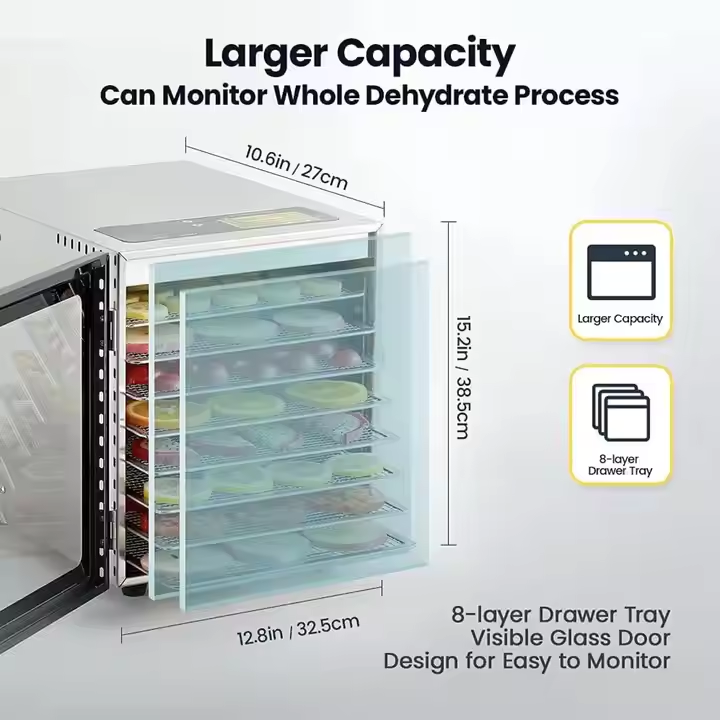
High-volume pet bakeries require aggressive output capabilities. Retail suppliers depend on large-scale processing to stock multiple storefronts. Established e-commerce brands use 12-tray units to maintain vast online inventory levels. This capacity matches the rigorous demands of multi-channel distribution.
Maximizing unattended drying cycles represents the highest return on investment per running hour. You can load twelve trays at the end of a shift. The machine processes heavy loads overnight while your staff sleeps. Staff arrive the next morning to fully cured, ready-to-package inventory.
Larger machines easily support bulk ingredient purchasing. Processing larger batches allows you to negotiate better raw material rates. Buying fifty pounds of beef heart is vastly more efficient than buying ten pounds. This bulk strategy significantly lowers your overall Cost of Goods Sold (COGS).
You must address specific implementation risks before upgrading. A 12-tray unit demands a larger dedicated footprint. It commands substantial counter space or heavy-duty floor racks. Increased moisture extraction requires robust room ventilation. Without proper exhaust management, humidity accumulates in your kitchen and disrupts the drying process.
Commercial pet treat manufacturing strictly prohibits subpar materials. Plastic trays degrade rapidly under continuous high-heat cycles. Micro-abrasions trap fat residues and absorb stubborn odors. Plastic racks consistently fail commercial health inspections due to biofilm buildup. We rely on 304-grade stainless steel for absolute sanitation. Kitchen staff can aggressively scrub stainless racks between batches of chicken, beef, or fish without damaging the surface.
Analog dials introduce dangerous temperature fluctuations. Pathogen control requires exact heat management. The USDA mandates raw poultry and beef reach a critical pathogen-kill phase. The internal meat temperature must hit 160°F+ before the exterior dries out. A Stainless Steel Digital Food Dehydrator provides precision control. Digital thermostats eliminate lethal guesswork by locking in exact ambient temperatures.
Airflow consistency separates professional equipment from hobbyist gear. Horizontal airflow utilizes powerful rear-mounted fans. It pushes heated air evenly across every single tier. The front of the first tray dries at the exact same rate as the back of the twelfth tray. This professional engineering eliminates the labor-wasting need to rotate racks manually mid-cycle.
We see numerous operators fail inspections due to uneven drying. Vertical airflow systems push air from the bottom up. They inevitably burn the bottom racks while leaving the top racks raw. Horizontal airflow ensures uniform moisture removal, guaranteeing maximum shelf stability for packaged treats.
Evaluating commercial machines goes beyond simply comparing their exterior dimensions. You must calculate the operational efficiency matrix. Determine the actual usable drying area per square inch. This metric reveals the true production value of the machine. A larger unit often provides disproportionately more tray space relative to its footprint.
Energy consumption heavily influences your daily operating efficiency. Compare the expected wattage against your local utility rates over a standard ten-hour processing cycle. An 8-tray unit typically draws between 600W and 800W. A 12-tray unit generally requires 1000W to 1200W.
Understanding these variables helps build a solid shortlisting logic. Below is an operational matrix comparing standard capacities.
Operational Metric | 8-Tray Capacity Model | 12-Tray Capacity Model |
|---|---|---|
Average Raw Meat Capacity | 8 to 10 lbs | 15 to 18 lbs |
Estimated Dried Yield | 2.5 to 3.5 lbs | 5.5 to 6.5 lbs |
Standard Wattage Draw | 600W - 800W | 1000W - 1200W |
Best Use Case Environment | Micro-kitchens, R&D labs | Commercial bakeries, retail |
Follow these specific guidelines when finalizing your selection. Every business handles unique daily constraints. We recommend breaking down your decision using the following logic paths:
Choose the 8-Tray if: Your weekly finished output stays strictly under 15 pounds. You operate in a shared commissary kitchen where space remains tightly restricted. You specifically need a secondary unit solely dedicated to testing new recipes or processing plant-based ingredients.
Choose the 12-Tray if: You supply established wholesale accounts. Your primary catalog features high-shrinkage muscle meats. Your demand forecasts confidently predict aggressive quarterly growth. You prioritize lowering active labor hours through overnight batching.
Monitor your electrical circuits before installation. Large models pull significant amperage. Plugging multiple high-wattage appliances into a single kitchen circuit causes frequent breaker trips. Ensure your facility provides dedicated outlets capable of supporting sustained commercial loads.
Purchasing decisions must align with your projected twelve-month sales volume rather than your current monthly output. Overestimating your short-term needs wastes valuable kitchen real estate. Underestimating your growth trajectory forces you into exhausting, continuous production cycles. Careful capacity planning preserves both your capital and your physical energy.
Take immediate action to prepare your production space. Audit your current prep stations to ensure adequate loading areas. Review your commercial kitchen's electrical capacity to guarantee safe, uninterrupted operation. Secure your selected dehydrator model to begin standardizing your batch times. Consistent processing environments guarantee safer, higher-quality pet treats for your expanding customer base.
A: We strongly discourage this practice. Vegetables and meats possess completely different moisture-release rates. Mixing them creates massive cross-contamination risks. Airborne fat particles from raw meat can easily settle onto sweet potatoes or apples. We recommend batching these ingredients on entirely separate days. Using a dedicated, separate unit for vegetables remains the safest operational standard.
A: It does not dry slower if engineered correctly. High-quality commercial units scale their fan size and wattage proportionally. The manufacturer increases the internal heating power to match the added tray volume. This proportional engineering maintains uniform drying times across both unit sizes. Always verify the wattage rating before purchasing.
A: Raw meat yields a 3:1 or 4:1 raw-to-dry ratio. You lose up to 70% of the initial weight through moisture evaporation. Three pounds of raw beef heart yields approximately one pound of finished jerky. Larger tray capacities remain critical. They allow you to process enough raw weight to generate meaningful, profitable final yields.


