
Please Choose Your Language
Views: 0 Author: Site Editor Publish Time: 2026-08-21 Origin: Site


Dehydrated food does not have an infinite shelf life by default. Its longevity is strictly dictated by moisture removal efficiency and storage conditions. Unpredictable spoilage, case hardening, and wasted food investments occur when users rely on inaccurate drying times, subpar entry-level equipment, or improper post-drying storage protocols. Many beginners expect indefinite preservation but end up with moldy batches weeks later. Achieving maximum shelf life requires treating dehydration as a two-part system. You can preserve trail meals for a few weeks or build emergency preparations lasting decades. Success demands precision moisture extraction using a reliable food dehydrator, followed immediately by hermetic storage environments. Mastering both phases eliminates guesswork, prevents bacterial growth, and protects your harvest year-round.
Baseline Expectations: Properly dehydrated fruits can last 1 year, vegetables around 6 months, and meats (jerky) typically 1 to 2 months at room temperature unless vacuum-sealed and frozen.
The 95% Rule: Long-term storage requires removing 90–95% of the food's moisture content, a metric heavily dependent on hardware temperature consistency.
Storage Multipliers: Combining fully dehydrated foods with Mylar bags, oxygen absorbers, and climate-controlled environments (cool, dark, dry) can extend shelf life up to 15–25 years for specific low-fat crops.
Hardware Dependency: Inconsistent airflow and temperature fluctuations in low-end equipment directly cause premature spoilage and manual discrepancies, making hardware selection a critical factor in food preservation ROI.
Defining "shelf-stable" requires understanding the biological makeup of the food you intend to dry. Shelf stability means the product resists microbial growth, retains nutritional value, and maintains palatable texture over a specific period. Different macronutrients, cellular structures, and acid levels react uniquely to moisture extraction. You cannot apply a universal expiration date to all dehydrated goods. Recognizing these baseline expectations prevents dangerous consumption errors and helps you plan your inventory rotation effectively. Water activity is the scientific measurement of unbound water in a food product. To stop bacterial growth, you must lower the water activity below 0.85. To stop mold and yeast, you must push it below 0.60. Different foods reach these safe zones at different physical textures.
Dehydrated fruits typically maintain a standard shelf life of about one year in a standard pantry environment. This extended longevity stems directly from their chemical composition. High levels of natural acids, such as ascorbic and citric acid, combined with concentrated natural sugars act as powerful secondary preservatives. Sugar binds to the minimal remaining water molecules, lowering the overall water activity and making the environment hostile to bacteria. Apples, apricots, and berries respond exceptionally well to this process. When testing fruit for doneness, you want a leathery texture. It should bend without snapping, but tearing it should reveal zero visible moisture beads along the break.
Vegetables lack these high sugar and acid concentrations. Consequently, low-acid vegetables like green beans, zucchini, and broccoli have a shorter baseline shelf life, usually hovering around six months in standard containers. Without sugar to bind residual moisture, vegetables are far more susceptible to rapid degradation in quality, flavor, and nutritional density. They often become brittle, lose their vibrant color, and develop a stale taste if left in standard pantry storage beyond the six-month mark. Extending vegetable shelf life requires aggressive moisture removal and immediate vacuum sealing. Vegetables must be dried until they shatter or snap cleanly when bent.
To maximize vegetable shelf life, follow these preparation steps:
Wash and cut vegetables into uniform pieces to ensure even drying rates across the entire batch.
Blanch low-acid vegetables in boiling water or steam for two to four minutes to halt enzymatic degradation.
Shock the blanched vegetables in an ice bath immediately to stop the cooking process before loading them onto trays.
Meat presents the highest risk in food preservation due to fat rancidity. Fat does not dehydrate. Even in a completely dry environment, lipids oxidize when exposed to trace amounts of oxygen, creating a foul odor and unsafe consumption conditions. Because of this, dehydrated meats and jerky have the shortest baseline shelf life, typically lasting only one to two months at room temperature in standard packaging. If you leave a piece of fatty beef jerky on the counter, the fat will turn white and smell like old paint within weeks.
To maximize meat preservation, you must select ultra-lean cuts like beef eye of round or venison. Trimming all visible fat before drying is non-negotiable. Applying curing salts containing sodium nitrite further inhibits bacterial growth, specifically botulism. Ground poultry, such as chicken or turkey, can be dehydrated safely if cooked thoroughly first and mixed with breadcrumbs to improve rehydration texture. However, to extend the viability of any dehydrated meat up to six months, you must store it in vacuum-sealed jars or bags and keep it in a dark, cool environment. Freezing vacuum-sealed jerky can extend its life to a full year.
Complex carbohydrates offer the highest potential for long-term storage. Dehydrated grains, pre-cooked beans, and starches like potatoes can easily last five to ten years, or even longer, when properly processed. The cellular structure of these foods allows them to release moisture uniformly without trapping pockets of water. They also contain virtually zero fat, eliminating the risk of lipid oxidation.
Preparation dictates the success of starchy foods. Beans must be fully cooked before dehydration to break down toxins like phytohaemagglutinin found in kidney beans, and to ensure they rehydrate properly later. Potatoes require blanching to stop enzymatic actions that cause them to turn black during the drying process. Once dehydrated to a hard, glass-like consistency, these carbohydrates become practically immune to standard spoilage as long as they remain protected from ambient humidity. You can test beans by hitting them with a mallet; they should shatter into dust and sharp shards.
Combining multiple ingredients into a single dehydrated meal introduces the "weakest link" rule. The shelf life of a combined trail meal, such as a dehydrated chili or a pasta dish, is strictly dictated by its fastest-spoiling ingredient. If you mix rice, which lasts years, with dehydrated ground beef, which lasts weeks, the entire meal expires when the beef goes rancid. The fat from the meat will slowly migrate into the rice, compromising the entire package.
For short-term trail viability, storing these mixed meals in standard zip-top bags works perfectly fine for one to three weeks. This covers most standard backpacking trips. However, if you are prepping meals for the next hunting season or a long-distance thru-hike months away, you must separate the fat-heavy ingredients from the stable carbohydrates. Package the dehydrated meat in its own small vacuum bag, and place that inside the larger bag containing the rice and vegetables. Alternatively, utilize vacuum sealing and freezer storage for the entire mixed meal until the day of departure.
Understanding the environmental threats to dried food allows you to build a reliable defense strategy. Spoilage is not random; it is a predictable biological and chemical reaction to moisture, oxygen, light, and heat. Controlling these variables directly translates to extending your food's viability. You must build a physical barrier between your processed harvest and the ambient environment.
Moisture is the primary catalyst for mold and bacterial growth. For long-term storage, you must reduce the internal moisture content of the food to below 10%. Achieving this target inhibits all fungal and microbial activity. However, pushing equipment to dry food faster often leads to a dangerous phenomenon known as case hardening. This is the most common mistake made by impatient users.
Case hardening occurs when drying temperatures are set too high. The intense heat rapidly bakes the exterior of the food, creating a hard, impermeable shell. This shell traps internal moisture inside the food piece. While the food feels dry to the touch, the hidden water pocket becomes a breeding ground for mold or, in low-acid environments, botulism. The physics of dehydration require capillary action to pull water from the center of the food to the surface. If the surface evaporates faster than the internal water can travel, the surface seals shut. Preventing case hardening requires steady, moderate temperatures that allow moisture to migrate naturally.
Even perfectly dried food degrades if exposed to the wrong elements. Oxygen fuels lipid oxidation, rapidly accelerating fat rancidity in meats and nuts. Furthermore, oxygen destroys sensitive vitamins, particularly Vitamin A and Vitamin C, stripping the food of its nutritional value over time. Aerobic bacteria also require oxygen to survive, making oxygen removal a primary defense mechanism.
Ultraviolet light and ambient heat break down cellular structures. Storing dried food in clear glass jars on a sunny kitchen counter guarantees rapid color loss and flavor degradation. The food will bleach out and look unappetizing. Heat acts as a catalyst for chemical reactions. The Q10 temperature coefficient rule states that every 18°F (10°C) increase in storage temperature cuts the shelf life of your food in half. A cool, dark, and oxygen-depleted environment is mandatory for preservation. Storing food at 50°F yields drastically better results than storing it at 75°F.
Hardware capabilities directly influence the biological stability of your end product. Beginners often purchase cheap, stackable units, only to return them after experiencing uneven drying and spoiled batches. The mechanics of your drying equipment dictate whether your food reaches the critical 95% moisture removal threshold safely. You cannot out-package poorly dried food. If the moisture remains in the cellular structure, the food will rot regardless of how many oxygen absorbers you use.
Airflow design separates reliable equipment from unreliable toys. Vertical airflow units, which feature a fan at the bottom or top of stackable trays, push air unevenly. The trays closest to the fan dry rapidly, while the furthest trays remain damp. This forces you to manually rotate trays constantly, introducing user error and inconsistent moisture levels. Every time you open the unit to rotate trays, you lose heat and disrupt the drying cycle.
Horizontal airflow systems utilize a rear-mounted fan to push air evenly across all trays simultaneously. This design guarantees consistent drying rates without manual intervention. Precise thermostat control pairs with horizontal airflow to prevent case hardening. If a machine's thermostat swings wildly by 15 degrees, you cannot trust the drying times listed in manufacturer manuals. Accurate temperature control ensures the food dries at the exact rate required for its specific cellular structure. A reliable thermostat maintains the set temperature within a two-degree variance.
Precision matters when processing delicate items. Herbs, medicinal flowers, and leafy greens require low, tightly controlled temperatures to retain their volatile oils and nutritional profiles. Drying basil at 130°F will destroy its flavor, leaving you with tasteless green dust. Dense root vegetables and thick cuts of meat require higher, sustained heat to penetrate their cores safely and eliminate pathogens.
Using a digital food dehydrator provides the micro-adjustments necessary for this level of control. Digital timers allow you to set specific run times, automatically shutting off the heating element to prevent over-baking once the target moisture level is reached. This digital precision maps directly to repeatable, predictable shelf-life outcomes. You remove the guesswork, ensuring every batch of apple slices or beef jerky achieves the exact same moisture content as the last. You can set the machine for 14 hours at 125°F and go to sleep, knowing it will power down exactly when required.
Volume demands often outpace entry-level equipment. Homesteaders, hunters processing large game, and small business owners quickly realize the limitations of standard consumer models. When you have a massive garden harvest or a hundred pounds of meat, processing in small batches leads to raw food spoiling while waiting in the fridge. You need throughput to handle seasonal gluts.
Upgrading to a commercial food dehydrator solves this bottleneck. These units feature high-wattage heating elements, heavy-duty stainless steel construction, and continuous run-time capabilities. They recover heat instantly when the door is opened and maintain rock-solid temperatures even when fully loaded with dense, wet foods. The return on investment becomes obvious when you eliminate raw food waste during peak harvest seasons and drastically reduce your overall batch processing times. A commercial unit can run for 72 hours straight without burning out the fan motor.
Mid-to-high volume users need spatial efficiency. You want maximum tray space without sacrificing counter space or drying performance. Evaluating the physical footprint versus the yield is a critical step in hardware selection. A machine with too little capacity forces you to run it constantly, driving up electricity costs and monopolizing your time.
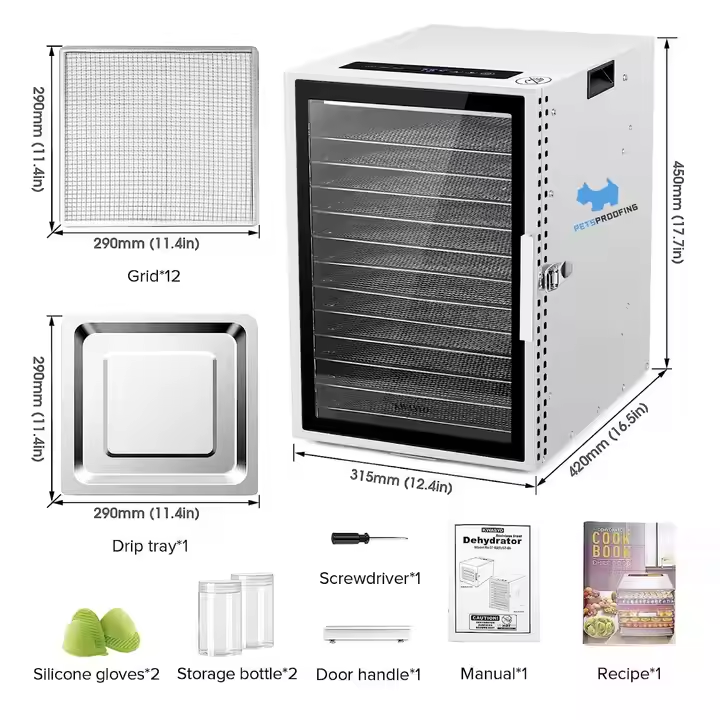
A 12 tray food dehydrator hits the sweet spot for serious preservationists. It offers enough square footage to process entire bushels of fruit or large batches of jerky in a single run. More importantly, well-designed models in this size category maintain consistent moisture extraction across all twelve trays. You load the machine, set the parameters, and walk away, knowing the top tray and the bottom tray will finish at the exact same time without manual rotation. The high wattage ensures the air remains hot even as it passes over twelve layers of wet produce.
The most common point of failure in food preservation happens after the machine turns off. Improper handling and choosing the wrong container for your intended timeline will ruin a perfectly dried batch. Bridging the gap between dehydration and consumption requires strict adherence to storage protocols. You must treat the packaging phase with the same attention to detail as the drying phase.
You cannot move food directly from the drying racks into long-term storage bags. Even with high-end equipment, slight variances in moisture can exist between individual pieces of food. One slightly damp strawberry can ruin an entire sealed bag by introducing enough moisture to spark mold growth across the entire batch.
Conditioning mitigates this risk. To condition your food, place the cooled, dried items loosely in large glass jars. Fill the jars only two-thirds full. Keep them at room temperature for 7 to 10 days. Shake the jars daily. This process allows any residual moisture to distribute evenly among all the pieces. The drier pieces will absorb the excess moisture from the damper pieces, creating a uniform water activity level. If you observe condensation forming on the inside of the glass during this week, the food is not dry enough. Put it back on the trays. If no condensation appears, the food is safe for long-term packaging.
Matching your packaging to your consumption timeline prevents wasted resources and ensures food safety. Over-packaging trail snacks wastes expensive Mylar, while under-packaging emergency prep guarantees spoilage.
Short-Term (1–3 weeks): Standard Ziploc bags and airtight Tupperware containers work perfectly for immediate use. This includes trail snacks, ultralight backpacking trips, and daily pantry grazing. These containers allow oxygen and light penetration, so use the contents quickly.
Mid-Term (1–3 years): Vacuum-sealed mason jars provide excellent protection for rotating pantry stock. Removing the oxygen extends the life of ground meats, jerky, and dried vegetables significantly. Glass prevents pest intrusion and odor contamination. You can reseal the jar multiple times using a vacuum attachment.
Deep Storage (5–25 years): Maximum longevity requires heavy-duty protection. You must use 7-mil Mylar bags paired with appropriately sized oxygen absorbers. Mylar blocks 100% of light and gas exchange. Once sealed with a heat iron, the oxygen absorber creates a nitrogen-rich vacuum environment, suspending the food in time. Do not use 3-mil bags for long-term storage, as sharp dehydrated foods like pasta or dried corn will puncture the thin material.
Packaging Mediums and Effective Lifespans
Packaging Type | Best For | Effective Lifespan | Oxygen Permeability |
|---|---|---|---|
Ziploc / Plastic Bags | Trail snacks, daily use | 1 - 3 Weeks | High |
Airtight Plastic Tubs | Short-term pantry storage | 1 - 3 Months | Medium |
Vacuum-Sealed Glass Jars | Rotating pantry stock, jerky | 1 - 3 Years | Zero (if seal holds) |
7-mil Mylar + O2 Absorber | Emergency prep, deep storage | 5 - 25+ Years | Zero |
Packaging alone cannot fight extreme environments. Where you place your sealed containers dictates their final shelf life. A Mylar bag stored in a hot attic will degrade much faster than one stored in a basement. Temperature fluctuations cause condensation inside poorly sealed containers, leading to rapid mold growth.
Establish strict environmental controls for your storage area. Keep temperatures consistently under 60°F (15°C). Ensure the space has zero direct sunlight exposure, as UV rays degrade packaging materials over time and break down the nutritional content of the food. Maintain low ambient humidity to prevent the exterior of metal cans or lids from rusting. A cool, dark, and dry root cellar, basement, or dedicated interior closet serves as the ideal location. Keep all storage containers elevated off concrete floors to prevent thermal transfer and moisture wicking.
Selecting the right equipment involves balancing your budget against your preservation goals. You must evaluate the conceptual trade-offs between entry-level plastics and professional-grade stainless steel. Assess your yearly harvest volume, the types of food you process most often, and your tolerance for manual intervention. If you process hundreds of pounds of apples every fall, a small plastic unit will frustrate you and waste your time.
Investing in quality hardware upfront prevents the hidden costs of spoiled food and wasted electricity. A robust machine with precise temperature controls, horizontal airflow, and adequate capacity ensures your preservation efforts yield safe, long-lasting results. Look for double-walled construction to retain heat and reduce energy consumption during long drying cycles.
Dehydrated Food Shelf Life and Storage Matrix
Food Category | Baseline Shelf Life (Pantry/Jar) | Extended Shelf Life (Mylar + O2 Absorber) | Primary Spoilage Risk |
|---|---|---|---|
High-Acid Fruits (Apples, Berries) | 12 Months | 15 - 20 Years | Moisture Reabsorption |
Low-Acid Vegetables (Beans, Carrots) | 6 Months | 10 - 15 Years | Nutrient Degradation |
Lean Meats / Jerky | 1 - 2 Months | Not Recommended for Deep Storage | Fat Rancidity / Oxidation |
Complex Carbs (Rice, Potatoes) | 2 - 5 Years | 20 - 25+ Years | Pest Intrusion |
Achieving maximum shelf life requires discipline in both the drying and storage phases. Follow these actionable steps to protect your food investments:
Always condition your dried fruits and vegetables in glass jars for a week before moving them to long-term storage.
Trim all visible fat from meats prior to drying, and store the finished jerky in vacuum-sealed containers to combat rancidity.
Upgrade to equipment with horizontal airflow and digital thermostats to eliminate case hardening and uneven moisture retention.
Package deep-storage items in 7-mil Mylar bags with oxygen absorbers, and store them in a climate-controlled space below 60°F.
A: You should avoid dehydrating high-fat foods. Fat does not lose its moisture during the drying process and will quickly go rancid at room temperature. Always choose ultra-lean cuts of meat and avoid drying avocados, butter, or fatty cheeses.
A: Signs of spoilage include visible mold, a foul or rancid odor, extreme discoloration, or a spongy texture where it should be brittle. If you detect any off-putting smells or see condensation inside a long-term storage bag, discard the food immediately.
A: Yes, blanching most vegetables is highly recommended. Blanching stops the enzymatic actions that cause color loss, flavor degradation, and tough textures. It also helps vegetables rehydrate much faster when you are ready to cook them.
A: You can reuse Mylar bags if you cut the heat seal carefully and wash them thoroughly, though they will be slightly smaller. Oxygen absorbers cannot be reused. Once exposed to ambient air, they deplete their iron powder capacity within hours and must be replaced.
A: Fruit turns black due to oxidation during the preparation and drying process. To prevent this, pretreat slices of apples, bananas, or pears with an ascorbic acid solution or lemon juice bath before placing them on the drying trays.
A: Yes, quality machines are designed for continuous operation. Models with digital timers and automatic shut-off features are completely safe to run overnight, allowing you to process dense foods that require 12 to 24 hours of drying time without interruption.


