
Please Choose Your Language
Views: 0 Author: Site Editor Publish Time: 2026-06-23 Origin: Site


The most significant bottleneck in any busy grooming business is rarely the washing phase. It is almost always the tedious, time-consuming drying phase. As daily volume scales up, professionals face a critical equipment decision to manage this bottleneck effectively. Should you rely entirely on traditional handheld high-velocity units, or should you integrate automated drying boxes to handle the heavy workload? Processing more dogs requires smart workflow strategies, not just harder manual labor. This guide breaks down the operational workflows, safety profiles, and exact use cases for both systems. You will learn how to make an evidence-based equipment investment tailored to your specific facility. We will help you optimize daily throughput without compromising animal safety, increasing anxiety, or sacrificing coat finish quality. Let us explore the right setup for your daily operations.
Handhelds are irreplaceable for finish quality: High-velocity handhelds remain mandatory for deshedding, straightening curly coats, and precise fluff-drying.
Drying boxes unlock parallel processing: Passive drying allows groomers to prep the next dog in the dog grooming tub, effectively doubling salon throughput for compliant coat types.
Safety metrics differ fundamentally: Handhelds carry risks of acoustic stress and localized skin irritation, while drying boxes require rigorous vetting for thermal regulation and ventilation fail-safes.
The optimal approach is hybrid: High-volume salons achieve the highest ROI by using boxes for initial damp-drying and handhelds for finishing touches.
Hand-drying requires constant active attention. It traps you at the grooming table. This effectively ties up expensive labor for 20 to 60 minutes per dog. We call this the labor trap. When you manually dry every pet, you severely limit your daily processing volume. You cannot bathe another dog. You cannot trim another dog. You just stand there holding a hose. Over a standard eight-hour shift, this active drying time consumes hours of potential styling time.
Furthermore, traditional blowouts cause massive workflow interruptions. Noise levels skyrocket easily. High-speed air blasts water and flying hair across the room. This chaotic environment disrupts the broader Pet Grooming Salon. It increases sensory fatigue for both your staff members and the animals. Dogs barking over the engine noise creates a stressful atmosphere. Groomers often end their day with ringing ears and irritated respiratory tracts from inhaling airborne dander.
You must evaluate your core objective before buying new gear. Your main goal is reducing active handling time per pet. However, you cannot compromise the final coat finish. You also cannot risk animal safety or increase their stress levels. You need solutions to streamline the transition from the wash basin to the styling table. The right equipment upgrades should boost throughput smoothly.
How do these classic tools actually work? They use a concentrated, high-velocity stream of room-temperature or slightly heated air. This airflow physically blasts water off the coat. They do not rely on evaporation. They rely entirely on sheer mechanical force to push moisture away from the skin.
Professionals love them for their undeniable efficacy. The primary advantages include:
Penetrating dense, double coats to force out dead undercoat. This mechanical action is absolutely essential for Huskies, Malamutes, and Golden Retrievers.
Allowing groomers to straighten hair while simultaneously drying. You cannot achieve proper Poodle and Bichon cuts without this stretching step.
Providing instant, tactile feedback. As you part the hair, you see the skin condition immediately. You easily spot hidden mats, hot spots, or parasites.
However, implementation carries real risks and downsides. The high decibel output can trigger severe acoustic stress. Cats and nervous dogs panic easily under this noise. Additionally, it demands intense physical exertion. Wielding a heavy hose all day contributes heavily to groomer arm and shoulder fatigue. Finally, you risk ocular or aural injury to the pet. You can cause severe damage if you accidentally misdirect the high-pressure nozzle into their eyes or ears.
Best Practice: Always use a "happy hoodie" or cotton balls to protect the dog's ear canals from high decibel noise. Keep the nozzle moving continuously to prevent skin burns.
Common Mistake: Holding the nozzle too close to a single spot for too long. This creates "whip knots" in long hair and can cause friction burns on sensitive skin.
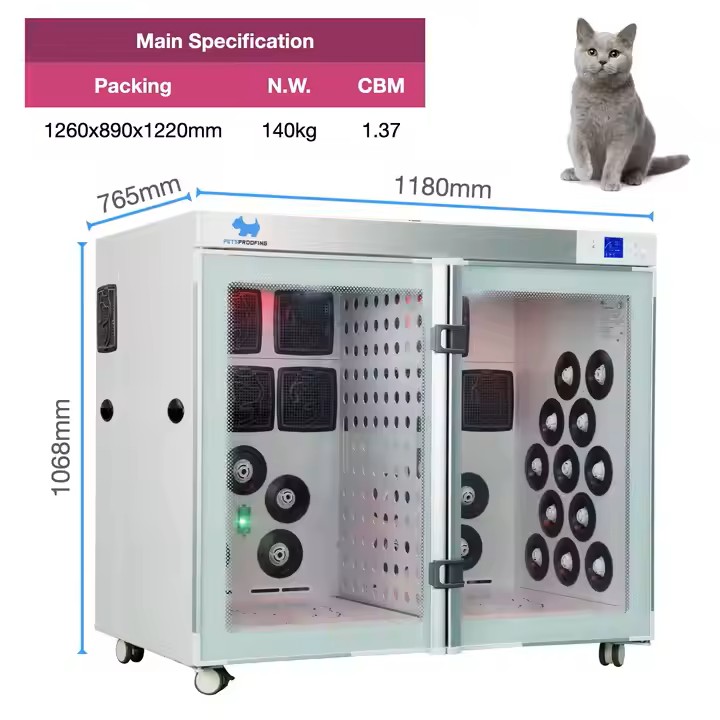
How do automated boxes work? They are enclosed cabins utilizing 360-degree ambient heat circulation. They use low-velocity airflow to gently evaporate moisture from the coat over time.
The primary advantages center entirely on efficiency and the pet experience:
Passive Labor: They free the groomer completely. You can safely move the next animal into the Pet Tub. This enables a continuous, highly profitable service loop.
Stress Reduction: They feature ultra-quiet operation. Felines, puppies, and sound-sensitive seniors tolerate this significantly better than loud blasters.
Containment: They keep hair and dander trapped safely inside the unit. You no longer have fur dispersed across your entire salon floor.
Yet, the implementation risks and downsides remain notable. You face a longer absolute drying time compared to high-velocity blasting. Passive evaporation simply takes longer. Also, they are completely ineffective for deshedding. You cannot fluff or straighten coats for scissor-finishing inside a box. Finally, they require strict size restrictions. You must never cram large breeds into undersized boxes. This restricts essential airflow and drastically increases animal anxiety.
Best Practice: Preheat the cabin for a few minutes before placing the pet inside. This prevents the initial shock of cold air and speeds up the evaporation process.
Common Mistake: Leaving a thick towel wrapped around the dog inside the box. This completely blocks ambient airflow and traps unwanted humidity against the skin.
You must evaluate your options rigorously. Start with thermal safety and compliance. You must evaluate drying boxes exclusively for redundant safety features. Look for multi-point thermal sensors and automatic overheat shutoffs. Ensure they feature physical ventilation gaps. They should never be fully airtight. Reject any units lacking real-time internal temperature displays.
Next, analyze coat type suitability. Drop coats, short coats, and cats are highly compatible with drying boxes. They dry evenly without excessive matting. Conversely, double coats and curly coats require a high-velocity Pet Dryer for proper separation and styling. You need the physical force to prevent tight ringlets from forming.
Finally, consider scalability and space. Calculate the footprint of a heavy-duty box versus a wall-mounted handheld unit. Compare this against your available square footage. Some salons mount handhelds on overhead booms to save space, while cabins require dedicated floor real estate.
Feature Dimension | High-Velocity Handhelds | Automatic Drying Boxes |
|---|---|---|
Active Labor Requirement | 100% constant groomer involvement | Almost entirely passive operation |
Coat Type Compatibility | All coats. Mandatory for curly/double coats | Best for short, smooth, or feline coats |
Noise Generation | High (Requires ear protection) | Low (Ultra-quiet ambient fans) |
Deshedding Capability | Exceptional mechanical hair removal | None (Relies purely on evaporation) |
Why is choosing just one option flawed? Relying only on handhelds caps your revenue by limiting daily volume. You physically limit your processing capability. Conversely, relying only on boxes results in poor grooming finishes and increased matting in long-haired breeds. You simply cannot execute a professional scissor trim on a naturally air-dried poodle.
The optimal workflow embraces a strategic hybrid approach.
Towel dry the pet thoroughly immediately after removing them from the Dog Grooming Tub. Squeeze out excess water gently using high-absorbency microfiber towels.
Place them in the drying box for 15 to 20 minutes. This passive phase removes roughly 70% of the ambient moisture. You can actively use this time to prep your next client.
Transfer the damp pet to your styling table. Execute a rapid 5 to 10 minute high-velocity handheld session. This final step straightens the coat, removes dead undercoat, and fluffs the hair perfectly for cutting.
You must audit your current schedule today. Determine your primary operational bottleneck. Figure out if active drying time or total table space limits your revenue before you allocate your equipment budget. If you turn away clients because you lack time, a cabin provides the "second set of hands" you desperately need.
The "better" pet dryer depends entirely on the specific phase of the grooming process. No single tool performs every function perfectly. Handheld systems dominate the styling and deshedding phases. Automated cabins dominate the bulk moisture removal phase.
We highly recommend investing heavily in a variable-speed handheld unit for long-term durability. It remains your primary styling weapon. You should then supplement your operation with a mid-sized, clinically safe drying box. This hybrid setup acts as a reliable "second set of hands" for manageable coats. You will safely scale your daily volume, protect your physical health, and deliver outstanding finishes.
A: No. You must highlight strict contraindications for brachycephalic breeds like Pugs, French Bulldogs, and Shih Tzus. These flat-faced dogs struggle severely with ambient heat and respiratory regulation. They require careful, room-temperature drying using a handheld unit under constant professional supervision.
A: A drying box requires realistic timeframes of 30 to 45 minutes of passive time. Handheld drying takes 15 to 20 minutes of active time. The total time is longer inside a box, but your active groomer time is reduced to near zero.
A: Firmly, no. Automated boxes do not physically separate matted hair. They also cannot blow out impacted undercoat. You still find pre-brushing or post-blasting absolutely necessary to achieve high-quality professional results.


