
Please Choose Your Language
Views: 0 Author: Site Editor Publish Time: 2026-09-30 Origin: Site


Grooming a 65 to 75-pound Golden Retriever without the right equipment takes a severe physical toll. Bending over a makeshift surface for hours leads to inevitable back strain for the groomer and increases the risk of injury for the dog. Golden Retrievers possess a dense double coat that requires extensive brushing, undercoat raking, and high-velocity drying. These sessions frequently exceed two hours. Purchasing the wrong size setup carries high practical costs. Tables that are too small leave the dog dangerously close to the edge during intense deshedding sessions, while oversized units consume valuable floor space. A common mistake is buying a smaller setup for a Golden Retriever puppy. You must purchase equipment sized for the dog's fully grown adult dimensions to avoid replacing it within a year. Selecting the proper grooming table requires evaluating exact breed dimensions, dynamic weight loads, and specific use cases.
Optimal Dimensions: A tabletop length of 42 to 50 inches (106–127 cm) and a width of 24 to 26 inches (60–66 cm) is the industry standard for adult Golden Retrievers.
Weight Capacity: Look for a minimum working load of 150 lbs to account for the dog's dynamic movement, not just static weight.
Ergonomics: An adjustable grooming table is critical for large breeds to prevent groomer fatigue during 2+ hour deshedding sessions.
Safety Hardware: Heavy-duty clamps and H-bar overhead arms are strongly recommended over single-arm setups for large, active retrievers.
To determine the minimum length needed, measure your Golden Retriever from the tip of the nose to the base of the tail while they are standing naturally. This measurement dictates the absolute minimum surface area required for the dog to stand without their paws resting on the outer edges. You must account for the dog's natural stance, which widens when they feel unstable or when they are resisting a grooming tool. Some home groomers argue for using 36-inch (90 cm) tables to fit tight spaces. This forces an adult Golden to stand rigidly, leaving zero room for shifting and drastically increasing the risk of slipping off the edge. A dog forced into a cramped stance will become fatigued and uncooperative much faster.
We establish 42 inches (106 cm) as the absolute minimum safe length for adult females. For large males, 46 to 50 inches (116–127 cm) represents the optimal professional size. This extra length allows the dog to comfortably reposition. It also gives you necessary space to maneuver clippers, shears, and slicker brushes around the hindquarters without stepping off your own center of gravity. When a dog has room to adjust its footing, its anxiety decreases, leading to a safer and more efficient session. Trimming the tail feathers or performing a sanitary trim requires the dog to stand square and still. If the surface is too short, the dog will continuously tuck its pelvis to avoid stepping off the back edge, making these specific grooming tasks nearly impossible to execute safely.
Width dictates both canine comfort and groomer reach. A 24-inch to 26-inch (60–66 cm) width provides enough surface area for the dog's wide stance. Golden Retrievers have broad chests and require a stable base of support. Anything narrower forces the dog to keep its paws uncomfortably close together, compromising their balance. When a dog feels off-balance, they will constantly shift their weight, making scissor work dangerous and unpredictable.
Conversely, a surface wider than 26 inches forces you to overextend your lower back to reach the opposite side of the dog. Grooming requires precise scissor work and heavy brushing. If you are constantly leaning across a 30-inch surface, you will develop shoulder and lumbar fatigue within the first hour. This specific 24 to 26-inch width range strikes the perfect balance between stability for the retriever and ergonomic access for you. You should be able to stand flat-footed against the edge of the frame and comfortably reach the dog's far shoulder with your shears without bending at the waist.
Static weight ratings only measure what the surface can hold when perfectly still. Dynamic force is entirely different. When a 75-pound Golden Retriever leans away from a high-velocity dryer, shifts its weight suddenly, or resists nail clipping, the downward force multiplies. A structure rated for exactly 75 pounds will wobble, flex, or collapse under dynamic stress. Dogs often drop their entire body weight when they decide they no longer want to stand, turning a 75-pound animal into a dead weight that shocks the frame.
You need a baseline capacity of 150 to 200 pounds to ensure complete structural safety during active sessions. This overhead accounts for the force generated when the dog resists restraint or attempts to sit down heavily. A higher weight capacity usually indicates thicker steel tubing, stronger welds, and a denser wood core in the tabletop, all of which contribute to a vibration-free experience. Vibration transfer is a major issue with cheaper frames; when the high-velocity dryer is running, a flimsy frame will vibrate aggressively, which travels through the dog's paws and causes severe anxiety.
Golden Retriever Dimensions and Equipment Match
Dog Profile | Minimum Length | Minimum Width | Recommended Weight Capacity |
|---|---|---|---|
Adult Female (55-65 lbs) | 42 inches (106 cm) | 24 inches (60 cm) | 150 lbs |
Adult Male (65-75+ lbs) | 46 - 50 inches (116-127 cm) | 24 - 26 inches (60-66 cm) | 200 lbs |
Growing Puppy | 42 inches (Buy for adult size) | 24 inches | 150 lbs |
This option is best suited for mobile groomers, occasional home users, and environments where equipment must be stored away between sessions. When evaluating these models, scrutinize the structural integrity of the folding legs under a heavy load. A 75-pound dog requires locking pins and reinforced steel hinges to prevent accidental folding. Look for goal-post style legs rather than independent folding legs, as the connected base provides superior lateral stability. The locking mechanism should feature a heavy-duty spring-loaded pin that snaps securely into the steel frame, rather than a simple friction lock.
Portability metrics matter heavily here. A quality large foldable grooming table typically has a net weight of roughly 35 to 40 pounds. It should fold down to a slim 3-to-4-inch profile, allowing it to slide easily behind doors, into closets, or under furniture. The main implementation risk is lower overall stability compared to fixed units. You may experience slight wobbling during heavy brushing or high-velocity blow-drying. To mitigate this, ensure the rubber feet are completely level and placed on a hard, flat floor rather than thick carpet. If you must set up on carpet, place a rigid plywood board underneath the feet to create a stable foundation.
This represents the gold standard for professional salons, aging groomers, or senior dogs dealing with arthritis and mobility issues. The biomechanical benefits are massive. You can lower the surface to just 12 inches off the ground, allowing the Golden to step on naturally without being lifted. Lifting a 75-pound dog multiple times a day is a primary cause of career-ending back injuries for groomers. Once the dog is secure, you raise the surface to your exact waist height. This adjustability allows you to change the height dynamically during the groom; you can raise it higher for detailed paw pad trimming and lower it for top-line brushing.
Look for robust motor durability, linear actuators, and a lifting capacity exceeding 200 pounds. Smooth foot-pedal operation is vital to prevent sudden jerks that startle the dog. While an electric grooming table carries a high upfront cost and a heavy permanent footprint, these factors are offset by career-extending ergonomic benefits and a drastically reduced risk of dropping or injuring the animal. The sheer weight of the chassis also eliminates all wobbling, providing a rock-solid platform that calms anxious dogs. The power cords must be routed safely away from the working area to prevent tripping hazards and to keep them out of reach of chewing puppies.
This serves as a mid-tier solution, offering height adjustment without relying on electrical components. Instead of a motor, you use a manual foot-pump mechanism to elevate the surface. When assessing an adjustable grooming table, test the stability of the central hydraulic piston. Large dogs shifting their weight to the far edge can cause off-center stress on the piston. X-style bases generally offer better stability than Z-style bases for heavy breeds because they distribute the weight more evenly across the floor footprint.
The trade-off is clear. It is more affordable than electric models and eliminates the need for power cords, making it versatile for different room layouts. However, pumping a 75-pound dog upward requires physical effort. The pumping action can also cause a slight jolting motion that may startle nervous dogs. Lowering the surface requires pressing the pedal all the way down to release the hydraulic pressure, which must be done smoothly to avoid a rapid drop. You must maintain control of the release valve with your foot to ensure the descent is slow and steady, keeping your hands on the dog to reassure them during the movement.
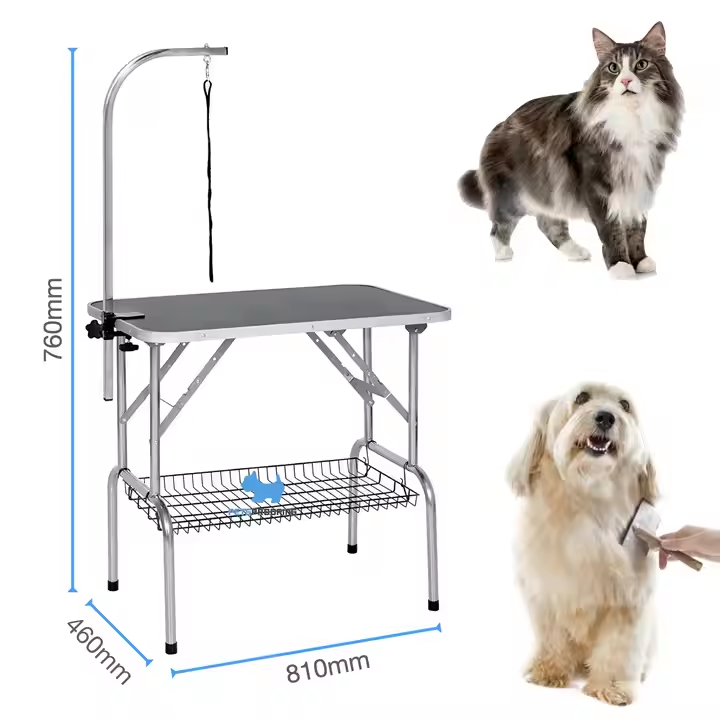
A standard 36-inch grooming arm is often too short for a tall Golden Retriever, forcing them to duck their head and disrupting their natural posture. You need an arm that extends high enough to keep the dog standing proudly. We strongly recommend the H-bar (overhead grooming arm) over the standard single-post arm. The vertical posts of the H-bar must extend at least 40 to 48 inches above the tabletop to accommodate the height of a large male Golden Retriever.
An H-bar spans the entire length of the setup and provides dual-point restraint. By attaching one loop to the neck and a belly strap or haunch support to the rear, you secure the dog completely. This prevents the Golden from spinning around, stepping off the edge, or sitting down repeatedly while you are trying to trim their hindquarters. Dual-point restraint is essential for large, active retrievers. When using a belly strap, ensure it is positioned just in front of the hind legs to support the dog's weight without compressing their internal organs.
The surface must feature a pebbled, non-slip rubber texture. When a Golden Retriever experiences stress or hears a loud high-velocity dryer, their paw pads sweat. Smooth surfaces become incredibly dangerous, causing the dog to splay its legs and panic. The pebbled rubber texture grips the pads, providing traction and confidence. Polyurethane blends tend to offer better grip and longevity than cheap PVC rubber, which can become slick when wet.
Furthermore, easy-to-clean, waterproof sealing around the edges is mandatory for hygiene. Many lower-quality models use aluminum edging that allows water, urine, and bacteria to seep into the core wood, causing it to swell and rot. Look for surfaces where the rubber is wrapped seamlessly over the edges or sealed with industrial-grade waterproof caulk. If the wood core absorbs moisture, it will warp, creating an uneven surface that compromises the entire structural integrity of the workspace.
Cheap plastic clamps are notorious failure points. When a strong retriever pulls against the loop, plastic snaps, sending the heavy metal arm crashing down. Always use heavy-duty aluminum or cast-iron adjustable arm clamps. The clamp is the only thing keeping the restraint system attached to the frame, making it a critical safety component.
These clamps must securely span various thicknesses, gripping at least 2 to 3 inches of the lip to prevent snapping under pressure. The clamp should feature a wide tightening knob that allows you to apply maximum torque by hand. Ensure the inside of the clamp is lined with a rubber pad to prevent it from gouging the tabletop surface when tightened. A bare metal clamp will quickly destroy the rubber edging and eventually slip off during a struggle.
Hardware Configuration Comparison
Hardware Component | Standard Option | Heavy-Duty Recommendation | Impact on Golden Retrievers |
|---|---|---|---|
Grooming Arm | Single-post (36 inches) | H-bar overhead (40-48 inches) | Prevents spinning and sitting; accommodates tall posture. |
Arm Clamp | Plastic screw-on | Cast-iron or Aluminum | Prevents snapping when a 75 lb dog pulls against the loop. |
Surface Edging | Riveted aluminum trim | Seamless wrapped rubber | Prevents water damage and wood core rot from wet paws. |
Before purchasing, map out your floor space using painter's tape. A 48-inch unit requires at least 3 feet of clearance on all four sides. This clearance allows the groomer to move effectively around the dog without tripping over cords, bumping into walls, or contorting their body to reach difficult angles. You need room to step back and evaluate the symmetry of your scissor work, especially when blending the feathering on the legs and chest.
If you place the setup against a wall to save space, you will constantly have to turn the heavy dog around to reach the other side. This defeats the purpose of having proper equipment and increases the risk of the dog stepping off the edge during the turn. Ensure your designated grooming area can accommodate the full footprint plus the necessary working radius. Keep the area clear of clutter, and install dedicated wall hooks for your clippers and dryers to keep the floor space unobstructed.
Different mechanisms require specific upkeep to ensure longevity. Electric motors need regular cleaning to keep dog hair out of the tracks, gears, and linear actuators. Hair buildup can strain the motor and cause premature failure. Use a compressed air canister to blow out the actuator tracks weekly. Hydraulic pumps must be checked periodically for fluid leaks and may require bleeding if air gets into the system, which presents as a spongy or unresponsive foot pedal.
If you store folding models in damp environments like garages or basements, rust becomes a serious risk on the joints and hinges. Wipe down all metal parts after every bath and apply a light silicone lubricant to hinges to maintain smooth functionality. Inspect the rubber surface regularly for tears caused by sharp nails, as water can penetrate these cuts and damage the wood core. Patch any small tears immediately with a waterproof rubber adhesive.
Preventative Maintenance Schedule
Task | Frequency | Mechanism Type |
|---|---|---|
Wipe down metal frame and dry hinges | After every use | All types |
Blow hair out of actuator tracks | Weekly | Electric |
Check for hydraulic fluid leaks | Monthly | Hydraulic |
Lubricate folding leg locking pins | Quarterly | Foldable |
Measure your dog from the tip of the nose to the base of the tail to establish your baseline length requirement.
Map out your designated workspace with painter's tape to verify you have a 3-foot clearance radius on all sides.
Evaluate your physical lifting capacity to determine if a motorized lifting mechanism is necessary for your daily routine.
Inspect the clamp thickness and arm style of any prospective model to ensure it supports dual-point restraint.
A: While technically possible for smaller females, using a 36-inch surface is highly discouraged for adult males. It lacks safety margins, restricts natural movement, and significantly increases fall risks. The dog is forced to stand rigidly, causing fatigue and anxiety during long deshedding sessions.
A: Always buy a table sized for the fully grown adult dog, which means 42 to 48 inches. Golden Retriever puppies grow rapidly. Buying a small surface now will require a costly replacement within months. A large surface works perfectly for a puppy and provides room to grow.
A: While adult Goldens typically weigh 55 to 75 pounds, the equipment should support at least 150 pounds. This overhead is necessary to handle dynamic movement, sudden shifts in weight, and the heavy downward pressure applied during brushing and deshedding safely.
A: Yes, if the owner grooms frequently, suffers from back issues, or owns a senior dog that cannot jump onto a static surface. The ability to lower the surface to the floor prevents lifting injuries and extends the groomer's physical longevity.
A: The ideal height depends entirely on the groomer. The surface should adjust so the dog's back is roughly level with the groomer's waist or lower chest. This prevents the groomer from bending over, protecting the lower back during long sessions.
A: Highly recommended. An H-bar allows for a belly strap or haunch support, keeping large, strong dogs secure. It prevents them from spinning around or sitting down during rear-end grooming, which is a common issue with single-post arms.


