
Please Choose Your Language
Views: 0 Author: Site Editor Publish Time: 2026-09-16 Origin: Site


The premium pet food market demands single-ingredient, air-dried, and minimally processed treats. Producers must shift from basic drying methods to precision-controlled environments. Scaling pet treat production introduces severe bottlenecks in moisture removal, pathogen control, and batch consistency. Inadequate equipment causes product recalls, inconsistent yields, and massive energy waste.
Pet owners demand absolute transparency regarding ingredient sourcing, production methods, and storage. A controlled dehydration workflow substantiates your quality and safety claims. Establishing a compliant production line requires aligning your facility’s workflow with the technical capabilities of your dehydration hardware. This guide breaks down the evaluation criteria for commercial dehydration workflows, from pre-processing raw meats to final moisture testing.
Compliance is Hardware-Dependent: Meeting FDA and FSMA standards for pathogen lethality requires equipment capable of sustaining precise temperature and humidity thresholds (typically between 135°F and 155°F) without fluctuation.
Material Selection Impacts Liability: Utilizing a stainless steel food dehydrator is critical for commercial operations to withstand aggressive sanitation protocols and prevent cross-contamination.
Batch Scalability Dictates Margins: Transitioning to a high-capacity, multi tray food dehydrator optimizes floor space and labor costs while maintaining uniform airflow across all product tiers.
Workflow Integration Prevents Bottlenecks: Dehydration is only one phase; successful operations must synchronize sourcing, dough mixing, slicing, tray loading, cooling, and packaging to prevent product spoilage and case hardening.
Moisture control dictates the safety and shelf life of your pet treats. You must distinguish between total moisture content and water activity (Aw). Moisture content measures the total volume of water in the product. Water activity measures the free water available for microbial growth. Pathogens like bacteria, yeast, and mold require free water to multiply. You must achieve a target water activity level below 0.85 Aw to inhibit microbial growth. Reaching this threshold extends shelf life naturally without relying on chemical preservatives. Consistent Aw testing ensures your treats remain stable during long-term storage and distribution.
Operators often confuse a dry-feeling surface with a safe Aw level. A treat can feel completely dry on the outside while harboring an Aw of 0.90 in the center. This internal moisture eventually migrates outward, causing mold blooms inside sealed packaging. Relying on physical touch or simple weight-loss calculations leaves your operation vulnerable to massive spoilage events. You must implement precise, instrument-based Aw testing for every batch before it leaves the processing floor.
Processing raw meats requires a validated kill step. Raw proteins harbor dangerous pathogens like Salmonella, E. coli, and Listeria. Regulatory bodies mandate strict time and temperature parameters to ensure product safety. You must document these parameters to maintain compliance with FDA and FSMA standards. The dehydration process must elevate the internal temperature of the meat to a lethal level before the exterior dries out completely.
Relying on dry heat alone fails to achieve lethality. If the air is too dry, moisture evaporates rapidly from the meat surface. This evaporation creates a cooling effect, keeping the internal temperature of the meat dangerously low even in a hot chamber. You must manage chamber humidity to suppress this evaporative cooling. Maintaining a higher humidity level during the initial phase forces the internal meat temperature to rise in tandem with the chamber temperature, ensuring a complete pathogen kill.
Raw meat loses up to 70% of its weight during dehydration. Uneven drying across a single batch destroys your profit margins. If some treats dry faster than others, you face severe packaging issues. Over-dried treats become brittle, lose nutritional density, and turn into dust during transit. Under-dried treats risk mold development and fail Aw testing.
Uneven batches force operators to overpack bags to meet minimum weight claims, giving away free product. Establishing a baseline for acceptable product variance is mandatory. Consistent yield relies entirely on uniform airflow and precise temperature control throughout the drying chamber. If your equipment suffers from dead zones where air fails to circulate, you will constantly battle inconsistent yields and wasted labor sorting good product from bad.
Quality control extends far beyond the drying cycle. Documented safety protocols must govern every step of your operation. This starts with auditing your raw ingredient suppliers and ends with final moisture testing before packaging. Consumers actively research brand safety records. Recalls destroy brand reputation overnight.
Implementing strict end-to-end quality control directly impacts consumer confidence. Transparent, documented processes allow you to position your products in the premium market segment. Your facility must operate with the same rigor as a human-grade food processing plant. Track lot numbers from the receiving dock through the grinder, into the drying chamber, and into the final retail pouch. If a failure occurs, you must have the data to isolate the exact batch immediately.
The preparation phase dictates the success of the drying cycle. For formed products, you must mix wet and dry ingredients into a uniform dough. Inconsistent mixing creates dense pockets that resist dehydration. Extruding the dough requires precise pressure to maintain uniform density. When processing whole muscle meats, slice thickness is your most critical variable. A variance of just one millimeter adds hours to a drying cycle. Thicker cuts require exponentially longer drying times and precise temperature adjustments to ensure the center reaches lethality.
Slicing raw meat at room temperature yields jagged, uneven cuts. To achieve precision, operators temper meat blocks down to 28°F before running them through industrial slicers. This semi-frozen state allows the blade to shear cleanly, producing uniform 5mm or 6mm slices. Uniform slices dry at the exact same rate, eliminating the need to manually sort finished treats.
You must enforce strict operational rules for tray loading. Mandate adequate spacing between individual pieces. Operators often overcrowd trays to increase batch size, which severely restricts airflow. You must maintain unobstructed horizontal and vertical airflow to remove moisture efficiently.
Calibrate slicers daily to ensure exact thickness across all muscle cuts.
Train operators to leave a minimum half-inch gap between all pieces on the tray.
Inspect loaded trays for overlapping edges before loading them onto the trolley.
Integrate automated wire-cut extruders for dough-based treats to eliminate human error entirely.
Dehydration requires a critical balance between heat and moisture removal. Heat forces moisture out of the product. Airflow carries that moisture away. You must evaluate standard operational ranges based on protein type, fat content, and desired end-product texture. Most meat-based treats require temperatures between 135°F and 155°F. Jerky requires a pliable texture, while biscuit treats require a brittle snap. Fat does not dehydrate. High-fat proteins require specific handling to prevent rancidity during the drying phase.
Integrating a reliable Food Dehydrator into your line allows you to utilize programmable multi-stage drying profiles. You cannot blast raw meat with maximum heat immediately. You must safely manage the gradual removal of water. A multi-stage profile might start with high heat and high humidity to achieve lethality. The system then automatically steps down the temperature and increases exhaust rates to finish the drying process gently. This optimizes moisture extraction rates and protects the nutritional integrity of the treat.
Monitoring the exhaust air provides real-time data on the drying progress. When the exhaust humidity drops to match the ambient room humidity, the bulk of the moisture removal is complete. Advanced systems use these humidity sensors to automatically transition between drying stages, removing the guesswork from the operator.
Removing treats from the heat source is not the final step. You must mandate an ambient cooling phase. Packaging warm treats traps residual heat, which turns into condensation inside the bag. Condensation creates localized high-Aw environments, leading to rapid mold growth. Move the loaded trolleys into a dedicated, climate-controlled cooling zone with high-velocity fans to bring the product down to room temperature rapidly.
You must detail standard operating procedures (SOPs) for batch testing using calibrated water activity meters. Test samples from different zones within the drying chamber to verify batch uniformity. Pull a sample from the top left, center, and bottom right of the rack. If the Aw readings vary by more than 0.02, your chamber has an airflow problem.
Packaging requirements dictate shelf stability. You must use high-barrier films to block oxygen and moisture transfer. Implement oxygen absorbers or nitrogen flushing to displace ambient air inside the package. These steps maintain the dehydrated state during transit. Establish strict guidelines for long-term storage conditions post-packaging. Finished goods must remain in climate-controlled environments to prevent moisture reabsorption and maintain the structural integrity of the treats.
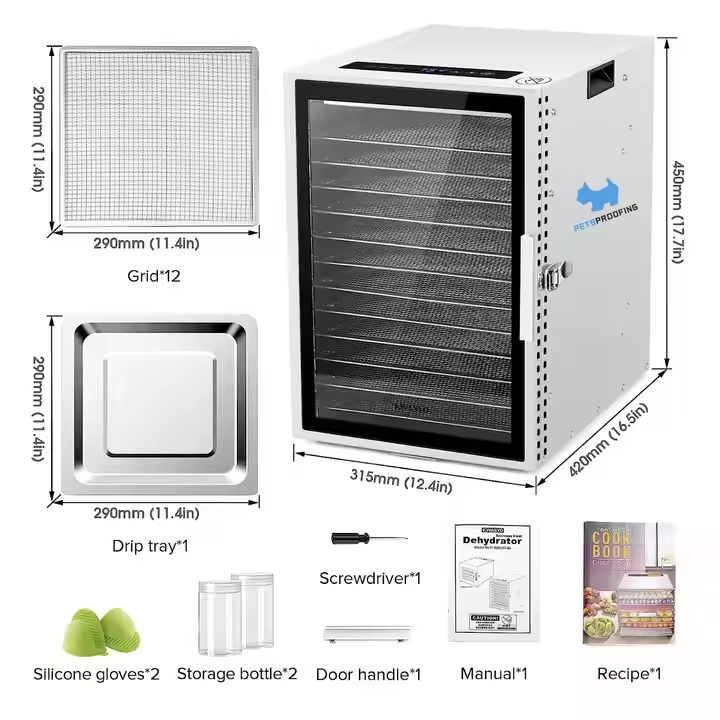
Scaling production exposes the limitations of prosumer equipment. Prosumer models suffer from motor burnout under continuous duty cycles. They lack the insulation required to maintain internal temperatures, leading to inconsistent heat distribution. Upgrading to a commercial food dehydrator is non-negotiable for serious operations. Commercial units feature heavy-duty fan motors designed for 24/7 operation. They utilize advanced airflow engineering.
Horizontal airflow pushes air evenly across every tray tier simultaneously. Vertical airflow often over-dries the bottom trays while leaving top trays raw. Dense meat products require variable speed fans to push air through heavily loaded chambers. When you load hundreds of pounds of wet meat into a chamber, the static pressure increases dramatically. Weak fans stall against this pressure. Industrial fans maintain their CFM (Cubic Feet per Minute) rating regardless of the load, ensuring consistent moisture removal.
Floor space directly impacts your operational overhead. You must analyze capacity-to-footprint ratios when selecting equipment. Calculate your required tray surface area based on daily wet-weight processing goals. A high-capacity multi tray food dehydrator maximizes vertical space, allowing you to process massive batches within a compact footprint.
You must also evaluate the labor implications of tray handling. Fixed racks require operators to load and unload individual trays by hand, wasting hours of labor. Removable trolleys and carts allow operators to prep an entire rack offline. They simply roll the loaded cart into the chamber, drastically reducing downtime between batches. While one batch dries, your team loads the next trolley. This continuous workflow maximizes the daily output of your food dehydrator.
Material choice is a strict food safety and compliance issue. Porous materials harbor bacteria and degrade under commercial use. Selecting a stainless steel food dehydrator ensures your equipment survives daily sanitation protocols. You must evaluate 304 versus 316-grade stainless steel. 316-grade offers superior resistance to acidic meat marinades, heavy salt concentrations, and caustic cleaning agents.
Plastic trays warp under high heat. Coated components chip and flake into the product stream. Fully welded stainless steel construction eliminates crevices where pathogens hide, ensuring your facility passes rigorous health inspections. Washdown procedures involve foaming the entire chamber with quaternary ammonia or peracetic acid, followed by high-pressure hot water rinses. Only heavy-gauge stainless steel withstands this daily abuse without rusting or pitting.
You must compare the financial realities of commercial dehydration against freeze-drying equipment. Freeze-drying requires massive initial capital investment. The vacuum chambers and refrigeration compressors demand specialized facility infrastructure. Air-drying requires significantly less upfront capital. You must also evaluate ongoing energy consumption. Freeze-drying runs long, energy-intensive cycles to achieve sublimation.
Using standard evaporation consumes less power per pound of processed meat. Assess the maintenance costs and facility requirements for each method. Dehydration requires adequate electrical load and exhaust venting, but avoids the complex mechanical maintenance associated with high-vacuum systems. Compressors fail, vacuum pumps require frequent oil changes, and specialized technicians charge premium rates for freeze-dryer repairs. Dehydration equipment relies on simple, robust heating elements and blower motors.
Processing methods define your product's market value. High-heat extrusion processes, used for standard kibble, destroy sensitive amino acids and enzymes. Gradual, low-temperature air-drying preserves the nutritional profile of raw ingredients. This method retains the natural color, aroma, and flavor of the meat. You must analyze how the chosen processing method impacts end-product texture.
Freeze-dried treats are porous and crumble easily. Air-dried treats offer a dense, chewy texture that dogs prefer. This directly impacts your market positioning. Label claims like "gently air-dried" command premium retail prices compared to heavily processed alternatives. The visual appeal of an air-dried muscle cut, showing the natural meat fibers, provides a massive marketing advantage over uniform, extruded pellets.
Processing Method | Moisture Removal Mechanism | Typical Temperature Range | End-Product Texture | Facility Infrastructure Needs |
|---|---|---|---|---|
Air-Drying (Dehydration) | Evaporation via heat and airflow | 135°F - 155°F | Dense, chewy, or brittle snap | Standard electrical, exhaust venting |
Freeze-Drying | Sublimation via vacuum and cold | -40°F to 120°F | Porous, lightweight, crumbly | High-voltage electrical, reinforced floors |
Extrusion (Kibble) | High heat and extreme pressure | 200°F - 300°F+ | Hard, uniform pellets | Industrial steam boilers, massive footprint |
Case hardening occurs when the exterior of the meat dries too rapidly. The outside forms a hard, impermeable shell. This shell traps internal moisture inside the treat. The product feels dry to the touch but will rot from the inside out within weeks. This poses a severe risk to product safety and brand reputation. Capillary action fails when the surface pores close prematurely.
To mitigate this, you must implement step-down temperature profiles. Start with higher humidity to keep the pores of the meat open while the internal temperature rises. Monitor exhaust humidity closely to ensure steady internal moisture migration before the exterior seals. If you notice the outside of the treats turning dark and hard while the center remains soft, immediately lower the chamber temperature and restrict the exhaust damper to build internal humidity.
Handling raw meat in the same facility as finished treats creates massive cross-contamination risks. A single drop of raw meat juice on a finished batch ruins the entire production run. You must design strict facility zoning. Designate "raw" zones for slicing and tray loading. Designate "ready-to-eat" (RTE) zones for cooling and packaging.
Personnel and equipment must never cross between these zones without full sanitation protocols. Install boot wash stations and require color-coded smocks for different zones. Utilizing pass-through dehydrator models allows operators to load raw meat on one side of a wall and unload finished treats on the clean side. This physical barrier provides the highest level of protection against airborne pathogens and accidental cross-contact.
Dehydration equipment extracts water from meat and expels it as hot, humid air. If you vent this exhaust directly into your processing room, the ambient temperature and humidity will spike rapidly. This creates a miserable working environment and forces your cooling systems to work overtime. The latent heat load from evaporating hundreds of pounds of water will overwhelm standard commercial air conditioning units.
You must identify the hidden costs of ambient heat. Evaluate units with insulated double-wall construction to keep heat inside the chamber. Plan for adequate facility ventilation. You must route dehydrator exhaust directly outside or install dedicated HVAC zones capable of handling massive dehumidification loads. Properly sizing your makeup air units ensures your facility maintains positive pressure, preventing outside contaminants from entering the clean rooms.
Achieving a profitable, safe pet treat line requires viewing dehydration not as a single step, but as an integrated workflow heavily dependent on the right hardware. Your success hinges on controlling variables from the slicing station to the packaging line. Base your equipment selection on three pillars: daily wet-weight capacity requirements, strict adherence to pathogen lethality standards, and the ability to execute rigorous sanitation protocols.
Calculate your target daily yield to determine the exact tray surface area required.
Assess your facility's electrical capacity and exhaust routing options before purchasing hardware.
Define your packaging strategy to ensure treats remain stable after leaving the drying chamber.
Request a technical spec sheet or arrange a pilot test with a commercial equipment manufacturer.
A: The ideal range typically falls between 135°F and 155°F. You must reach internal lethality temperatures based on USDA and FDA guidelines to eliminate pathogens like Salmonella. You will need to adjust specific temperatures based on the fat content and thickness of the meat cuts.
A: Commercial operations require non-porous surfaces to prevent bacterial harboring. Stainless steel withstands harsh, high-temperature chemical washdowns and resists corrosion from acidic marinades and salt. Plastic components warp, degrade, and pose severe cross-contamination risks under continuous industrial use.
A: You prevent case hardening by controlling initial drying temperatures and managing chamber humidity. You must allow internal moisture to migrate to the surface and escape before the exterior forms a hard, sealed shell. Programmable step-down drying profiles automate this process safely.
A: Air-drying uses gradual heat and airflow to evaporate moisture, resulting in a dense, chewy texture. Freeze-drying freezes the meat and uses a vacuum to remove moisture via sublimation, creating a porous, crumbly texture. Freeze-drying requires significantly higher initial equipment costs and energy consumption.
A: Simple moisture content percentages are insufficient for safety. You must test for Water Activity (Aw) using specialized, calibrated meters. Aw measures the free water available for microbial growth. Achieving an Aw below 0.85 ensures the treats remain shelf-stable without chemical preservatives.
A: You must maintain zero contact between individual pieces. Leave adequate negative space around every treat to allow unobstructed horizontal airflow across the tray. Overcrowding blocks the air boundary layer, leading to uneven drying times and inconsistent batch yields.
A: Store finished treats in cool, dry, climate-controlled environments. You must use high-barrier packaging films to block oxygen and humidity. Implementing oxygen absorbers or nitrogen flushing prevents moisture reabsorption after the product leaves the commercial food dehydrator.


