
Please Choose Your Language
Views: 0 Author: Site Editor Publish Time: 2026-08-22 Origin: Site


Professional pet grooming demands intense physical labor. Lower back pain, shoulder strain, and repetitive stress injuries frequently shorten careers. These physical tolls often stem directly from poor workstation ergonomics. A static workstation forces you to bend, reach, and twist to accommodate the dog. You must adapt the workstation to your body instead. Incorrect sizing leads to severe daily fatigue. It limits your daily appointment volume. It also compromises safety when handling anxious or aggressive pets.
Finding the correct working height requires a dynamic range rather than a single fixed number. Calculating your baseline ergonomic needs dictates your equipment choices. Whether you prefer to sit or stand changes your required table specifications completely. This baseline determines if you need static, hydraulic, or electric lifting mechanisms. We will explore how to establish the perfect setup for your salon.
The Baseline Ergonomic Rule: The optimal working height for a pet grooming table generally aligns the grooming surface (or the top of the dog's back) just below the groomer’s elbow level, requiring a dynamic range of 20 to 44 inches depending on breed size.
Mechanism Dictates Capability: An adjustable grooming table is mandatory for multi-breed salons; the choice between hydraulic and electric depends on load capacity requirements, budget, and access to power outlets.
Safety and Load Realities: Lowering capabilities (minimum height) are just as critical as maximum height, particularly for senior or giant breeds that cannot be safely lifted onto the table.
Horizontal Reach Matters: Vertical height is only half the equation; the width of the grooming table must allow the groomer to reach the dog without compromising posture or leaning excessively.
Occupational therapists use the "elbow-height rule" to determine proper workstation ergonomics. You apply this exact principle to pet grooming. Your arms should bend at a 90-degree angle while working. Your wrists must remain straight while manipulating shears or clippers. The top of the dog's back should sit just below your elbow level. If the dog sits too high, you will shrug your shoulders. This constant shrugging causes rotator cuff impingement. If the dog sits too low, you will flex your lumbar spine. This forward flexion leads directly to chronic lower back pain.
A pet grooming table must accommodate these physical requirements. You cannot compromise your posture for the animal. The equipment must bridge the gap between your natural stance and the dog's physical dimensions.
Many professionals use an ergonomic grooming stool to reduce leg fatigue. Introducing a stool drastically alters your required working height. When you sit, your elbow height drops by roughly 12 to 18 inches. You need a workstation that accommodates this massive shift. Groomers who alternate between sitting and standing require equipment with a fast, wide adjustment range. You cannot pause a groom for five minutes to manually adjust legs. The transition must happen smoothly mid-groom.
Consider the physical mechanics of seated grooming:
Your feet must rest flat on the floor or on a dedicated footring to stabilize your core.
Your knees should sit slightly below your hips to maintain a neutral pelvic tilt.
The table must lower enough so your forearms remain parallel to the floor while scissoring the dog's legs or underbelly.
The chassis must provide enough clearance underneath so your knees do not strike the metal frame.
You cannot rely on a single fixed height in a commercial setting. You must calculate your required dynamic range. Take your standing elbow height. Subtract the height of the dog from its paws to its shoulders. The resulting number is your ideal tabletop height.
Consider a groomer with a 40-inch elbow height. Grooming a Standard Poodle (24 inches tall) requires a table height of 16 inches. Grooming a Toy Poodle (10 inches tall) requires a table height of 30 inches. This simple math proves why static tables fail in professional environments. You need a minimum travel distance of 14 inches just to handle these two breeds comfortably.
Here is a practical breakdown of target table heights based on a standard 40-inch groomer elbow height:
Dog Breed Size | Average Dog Height (Shoulders) | Target Table Height (Standing) | Target Table Height (Seated - 28" Elbow) |
|---|---|---|---|
Toy (e.g., Pomeranian) | 8 - 10 inches | 30 - 32 inches | 18 - 20 inches |
Small (e.g., Miniature Schnauzer) | 12 - 14 inches | 26 - 28 inches | 14 - 16 inches |
Medium (e.g., Cocker Spaniel) | 15 - 17 inches | 23 - 25 inches | Not recommended (too low) |
Large (e.g., Golden Retriever) | 22 - 24 inches | 16 - 18 inches | Not recommended (too low) |
Different breeds demand entirely different vertical clearances. Toy and small breeds require significant elevation. Shih Tzus, Pomeranians, and Toy Poodles force you to hunch over if the table remains too low. You must elevate the surface to 36–44 inches for these tiny dogs. This keeps your spine neutral and your focus sharp.
When executing a precise Asian Fusion trim on a Toy Poodle, your shears must remain perfectly parallel to the table surface. If the table sits too low, you will drop your elbow, altering the shear angle and ruining the bevel. Elevating the table to 40 inches locks your elbow against your ribs, providing maximum stability for detail work.
Conversely, large and giant breeds require massive drops in elevation. Newfoundlands, Great Danes, and Mastiffs take up substantial vertical space. You must drop the table to 12–24 inches. This low clearance allows you to reach over the dog's back without straining your shoulders. You can comfortably brush out thick double coats using your body weight rather than just arm strength. A versatile Grooming Table handles both extremes effortlessly.
Choosing the right lifting mechanism defines your daily workflow. You must match the technology to your physical needs and salon layout. Each mechanism offers distinct advantages and specific limitations. Understanding these mechanical differences prevents costly equipment mistakes.
An electric grooming table utilizes linear actuators to drive the lifting mechanism. You control the movement via foot pedals or hand remotes. This system provides incredibly smooth, jolt-free movement. Smooth elevation is crucial for nervous, reactive, or senior pets. Sudden drops or jerky lifts can trigger a panic response in anxious dogs.
Electric models boast the highest weight capacities on the market. Many commercial units easily handle loads exceeding 250 pounds. They also allow for precise micro-adjustments. You can tap the pedal to raise the dog a single inch for better shear access.
However, electric systems carry specific risks and requirements. You must position the table near electrical outlets. Cords can create tripping hazards if not managed properly. You also face the risk of motor failure. Replacing a burnt-out actuator requires specialized parts and downtime. When evaluating electric models, you must differentiate between static weight capacity and lift capacity. Static capacity dictates what the table can hold while stationary. Lift capacity dictates what the motor can smoothly elevate without straining or overheating.
Key operational protocols for electric models:
Always route power cables through heavy-duty floor covers to prevent tripping.
Keep foot pedals wrapped in waterproof covers to prevent moisture damage during bathing prep.
Never exceed the stated lift capacity, even if the static capacity is higher.
Inspect the actuator worm gear monthly for hair buildup or debris.
A hydraulic grooming table relies on a fluid-driven piston. You operate the mechanism by pumping a manual foot lever. This design eliminates power cords entirely. Cordless operation makes hydraulic units ideal for central salon islands. You can walk 360 degrees around the table without tripping over wires.
Hydraulic systems are highly durable in wet environments. They excel in bathing rooms where electric components would pose a safety hazard. The sealed fluid cylinders resist moisture and chemical corrosion effectively.
The manual nature of hydraulics introduces some drawbacks. The lifting motion can feel jerky if the pump mechanism becomes worn or if air enters the fluid line. You must exert physical effort to pump the pedal. Lifting a 150-pound dog requires significant leg strength and repeated pumping. Over time, hydraulic seals degrade. You may experience hydraulic fluid leaks, requiring cylinder replacement or rebuilding.
Hydraulic fluid viscosity changes with temperature. If your salon gets cold overnight, the pump may feel sluggish during your first morning appointment. Allow the fluid to warm up by cycling the pedal a few times before placing a heavy dog on the surface. Despite these maintenance needs, they remain a staple in rugged grooming environments.
A foldable grooming table features static legs secured by locking pins. You can collapse the legs flat against the underside of the tabletop for transport. These units are lightweight and inexpensive. They are absolutely essential for mobile groomers, house-call professionals, and dog show competitors. You can easily load them into a van or carry them into a client's home.
The primary limitation is the lack of dynamic height adjustment. You cannot change the height during a groom. You must set the leg pins before placing the dog on the surface. This forces ergonomic compromise. You will likely hunch over small dogs and reach uncomfortably over large ones.
Foldable models also feature lower weight limits. They lack the structural mass needed to stabilize giant breeds. A heavy, thrashing dog can cause a folding table to wobble dangerously or collapse. You must strictly adhere to the manufacturer's weight limits when using portable equipment.
Mobile groomers face the strictest space limitations. A foldable unit must fit between the wheel wells of a standard cargo van. Measure the folded dimensions carefully. Some heavy-duty folding models feature thick tubular steel legs that add significant bulk, making them difficult to slide under shelving units.
Mechanism Type | Primary Advantage | Primary Limitation | Best Use Case |
|---|---|---|---|
Electric | Smooth, effortless micro-adjustments | Requires power access; cord management | High-volume commercial salons |
Hydraulic | Cordless operation; wet-room safe | Requires manual pumping effort | Center-room islands; bathing areas |
Foldable | Maximum portability; lightweight | Fixed height during operation | Mobile grooming; house calls; shows |
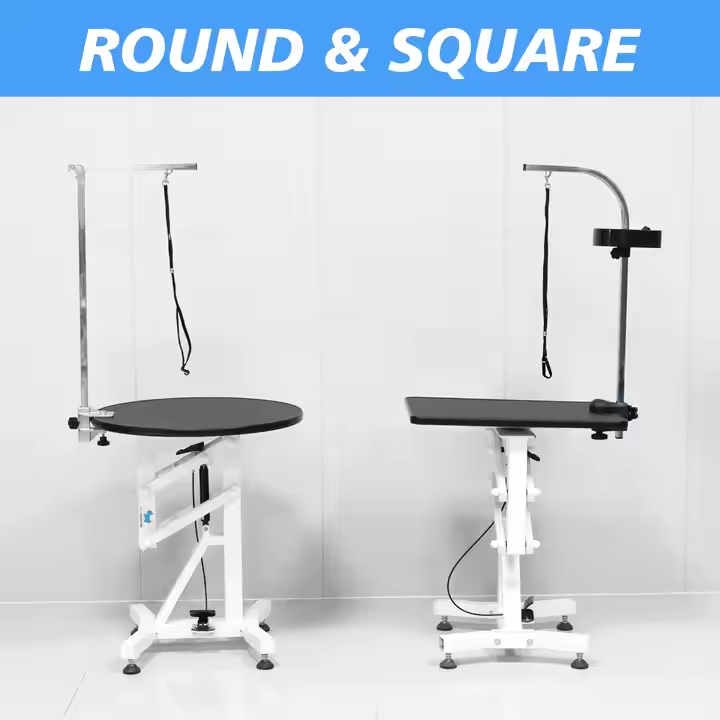
You must look beyond the lifting mechanism to evaluate the entire workstation. Every component impacts your physical health and grooming efficiency. Analyzing these specific features ensures you select equipment that actively supports your daily operations.
Evaluate the total travel distance of the chassis. Maximum height accommodates tiny breeds, but minimum height dictates safety for large dogs. A minimum drop to 12-16 inches is a strict requirement for high-volume salons. Geriatric dogs, dogs with hip dysplasia, and giant breeds cannot jump. You cannot safely lift a 100-pound dog onto a 24-inch surface multiple times a day. Doing so guarantees a spinal injury.
The table must lower enough for the dog to simply step onto the surface. Once the dog steps on, the motor or pump does the heavy lifting. An adjustable grooming table with a low clearance profile protects both your back and the dog's joints.
Vertical height represents only half the ergonomic equation. The width of the tabletop dictates your horizontal reach. A table that is too wide forces you to lean forward. If you place a Yorkie on a 30-inch wide table, you will bend at the waist to reach the dog. This completely negates the benefits of proper vertical height.
Select a width that matches your arm length and typical breed size. Standard widths range from 24 to 28 inches. Use a narrower table for small dogs to keep them close to your core. Reserve wider 30-inch tables strictly for large breeds that need the footprint.
The restraint system must scale with the table. Single L-arms work well for small, cooperative dogs. Overhead H-frames provide superior security for large or difficult pets. An H-frame distributes the restraint points, preventing the dog from spinning or sitting down unexpectedly.
The height adjustability of the grooming arm is critical. If the arm does not extend high enough, it will choke a tall dog. If it does not drop low enough, a small dog will step off the edge of the table. Ensure the clamps secure tightly without damaging the tabletop edge. Heavy-duty aluminum clamps resist bending better than cheap plastic alternatives.
Chassis design dictates stability during aggressive brushing or dematting. You have three primary frame styles to consider:
X-Style Frames: Offer excellent vertical range but often shift slightly horizontally as they rise. This scissor-lift design is common and reliable.
Z-Style Frames: Eliminate horizontal drift. A Z-frame goes straight up and down, maintaining a perfectly consistent footprint. This is ideal for tight spaces.
H-Base Frames: Provide maximum floor contact for heavy loads. The wide base prevents tipping when a large dog leans against the grooming arm.
Regardless of the frame style, you must have adjustable leveling feet. Salon floors are rarely perfectly flat. Uneven floors cause the table to rock. A rocking table terrifies dogs and ruins your scissor finish. Adjust the leveling feet to maintain a true, stable working surface.
The tabletop material impacts both pet comfort and salon hygiene. Avoid smooth surfaces. Dogs slip on smooth materials, increasing their anxiety and making them harder to groom. Look for pebble-textured rubber or high-density polyurethane. These textures provide excellent grip for paw pads.
The surface must also resist moisture and chemicals. You need a material that wipes clean instantly. Porous surfaces absorb urine, feces, and anal gland secretions. This leads to foul odors and cross-contamination between appointments. A sealed, textured surface prevents these issues while keeping the dog secure.
Integrating new equipment into your workspace requires careful planning. You must account for physical dimensions, power access, and long-term upkeep. Proper implementation maximizes the lifespan of your equipment and streamlines your daily workflow.
Measure your available floor space before purchasing. Adjustable tables require a larger operational footprint than static models. You must account for the moving parts. Electric tables require strict cable management. Route cords through floor covers or drop them from the ceiling. Loose cords near water and sharp tools create severe safety hazards.
Hydraulic tables need clearance for the foot pump action. You must leave enough room to comfortably swing your leg and pump the pedal without hitting walls or cabinets. Ensure you have at least three feet of clearance around all sides of the table for unimpeded movement.
Commercial grooming equipment endures brutal conditions. Hair, dander, water, and chemical sprays constantly attack the moving parts. You must implement strict maintenance protocols.
For X-style and Z-style frames, lubricate the pivot joints monthly. Use a dry silicone spray rather than wet grease. Wet grease attracts hair and creates a sticky sludge that binds the mechanism. For hydraulic units, check the cylinder seals for fluid weeping. Wipe down the piston shaft weekly to remove hair buildup.
For electric units, protect the foot pedals from water ingress. Linear actuators rely on a threaded rod spinning inside a nut. If hair wraps around this rod, it binds the motor, causing it to draw excess amperage and eventually burn out. A simple weekly vacuuming of the exposed tracks prevents this catastrophic failure. Proper maintenance extends the lifespan of a premium table well beyond a decade.
Measure your seated and standing elbow height to establish your baseline vertical requirements before purchasing any equipment.
Audit your daily breed schedule to determine the necessary weight capacity and minimum lowering height needed for your specific clientele.
Map your salon floor plan to verify clearance for foot pedals, hydraulic pumps, or power cords.
Inspect the surface texture of potential models to ensure adequate paw grip and sanitation ease.
A: Standard fixed tables usually sit 30 to 36 inches high. Adjustable tables range from 12 to 44 inches to accommodate different breeds and groomer heights.
A: Base the tabletop dimensions on the length of the dog from its nose to the base of its tail, adding 4 to 6 inches as a buffer. Ensure the static weight capacity exceeds the dog's actual weight by at least 20 percent. The table width should not force you to overreach or lean forward during the groom.
A: Yes. When you sit on a stool while grooming, your elbow height drops significantly. You will need an adjustable table capable of lowering to 20 or 24 inches. This lower range allows you to maintain proper arm angles and neutral spine alignment while working from a seated position.
A: Electric tables provide smooth, effortless lifting and handle higher capacities, making them ideal for heavy daily salon use. Hydraulic tables offer cordless convenience and rugged durability in wet environments at a lower price point. Your choice depends entirely on your need for precise micro-adjustments versus cordless mobility.
A: While heavy-duty foldable tables exist, they present severe limitations for large breeds. They lack the low-height access required for heavy dogs to step onto the surface safely. This forces you to physically lift the animal. They also lack the structural mass to remain completely stable if a giant breed thrashes.
A: For salons handling large, senior, or mobility-impaired dogs, the table should lower to at least 12 to 16 inches from the floor. This minimal clearance allows heavy dogs to simply step onto the platform without jumping. It completely eliminates the need for you to lift heavy animals, preventing severe back injuries.
A: You must keep hair and dander out of the actuator tracks or hydraulic pistons. Wipe down the metal chassis regularly to prevent rust from moisture and chemicals. Adjust the leveling feet to prevent chassis warping. Periodically check hydraulic fluid levels for leaks and inspect electric cables for fraying or water damage.


