
Please Choose Your Language
Views: 0 Author: Site Editor Publish Time: 2026-09-18 Origin: Site


Inconsistent moisture content in pet food and treats creates severe operational risks. It directly threatens production lines with microbial growth, mold proliferation, and product recalls. When scaling pet food manufacturing, plant managers face a complex challenge. You must maintain exact water activity (Aw) levels across varying batch sizes, differing ingredient densities, and fluctuating ambient facility conditions. A slight deviation in moisture extraction compromises an entire production run. This leads to wasted raw materials and dangerous shelf-stability failures.
Achieving verifiable, repeatable batch consistency relies entirely on the technical architecture of your drying equipment. Facilities must move beyond basic drying concepts and focus on rigorous mechanical evaluation. Standardizing production across multiple shifts depends on precise airflow engineering, thermal mass stability, and automated environmental controls. Understanding these mechanical variables allows operators to eliminate dead zones, prevent case hardening, and guarantee every piece of pet jerky meets strict safety specifications before packaging.
Airflow Architecture Dictates Consistency: Horizontal, laminar airflow prevents the uneven moisture distribution commonly found in vertical-flow systems.
Material Selection Impacts Thermal Stability: High-grade materials stabilize internal temperatures, making a stainless steel food dehydrator critical for repeatable results.
Automation Reduces Operator Error: Programmable Logic Controllers (PLCs) and multi-stage recipe programming are mandatory for standardizing batches.
Capacity Requires Proportional Power: Scaling to a commercial food dehydrator demands evaluating the ratio of fan velocity and heating wattage to total tray surface area.
Understanding the exact metrics of successful dehydration requires separating total moisture content from water activity. Total moisture measures the absolute volume of water inside a product. Water activity (Aw) measures the free, unbound water available to support the growth of bacteria, yeasts, and molds. Hitting a specific Aw target is the primary success metric for shelf stability in pet treats. Most commercial pet jerky and dehydrated meats require an Aw level strictly below 0.60 to prevent microbial proliferation during prolonged storage at room temperature. Failing to hit this exact metric across every tray in a batch renders the product unsafe for retail distribution.
Rising raw meat and specialized protein costs make batch waste financially devastating for processing facilities. High-quality proteins like beef liver, salmon, and venison carry significant upfront expenses. When a batch dries unevenly, the facility loses the raw material cost, the labor hours invested in preparation, and the energy consumed during the drying cycle. In this environment, a high-performance Food Dehydrator acts as a yield-protection asset. It maximizes raw material returns by ensuring uniform moisture extraction, thereby eliminating the need to discard under-dried or over-dried product.
The operational impact of uneven drying extends far beyond immediate material loss. Poor equipment choices frequently lead to batch rework. Operators must manually sort through trays to separate finished pieces from those requiring additional drying time. This drastically increases labor costs and disrupts production schedules. Aggressive or uneven heat application also causes case hardening. This phenomenon occurs when the exterior of the meat dries too rapidly, forming a hard shell that traps internal moisture. Case-hardened products may pass initial visual inspections but will inevitably develop mold from the inside out once packaged.
Consistent product appearance, texture, and Aw are mandatory for securing wholesale co-manufacturing contracts and building consumer brand loyalty. Commercial partners demand strict adherence to product specifications. If a facility delivers a pallet of pet treats where one bag contains brittle, over-dried jerky and another contains soft, under-dried pieces, the contract is immediately jeopardized. Retailers and brand owners require absolute uniformity to maintain consumer trust in a highly competitive market.
Consistent drying data forms the backbone of regulatory compliance. The Food Safety Modernization Act (FSMA) and Hazard Analysis Critical Control Point (HACCP) frameworks require facilities to prove that their processes consistently eliminate biological hazards. Automated drying logs demonstrating that every batch reached the required lethality temperature for the required duration protect the facility during audits. Without uniform drying capabilities, proving compliance becomes a logistical nightmare requiring excessive manual temperature probing and manual record-keeping.
To establish a baseline for success, plant managers should track the following metrics during every production run:
Target Water Activity (Aw) variance between the top, middle, and bottom trays.
Total moisture loss percentage from raw weight to finished weight.
Time required to reach the USDA-recommended lethality temperature for the specific protein.
Energy consumption per pound of finished product.
Percentage of product rejected during final Quality Assurance (QA) checks.
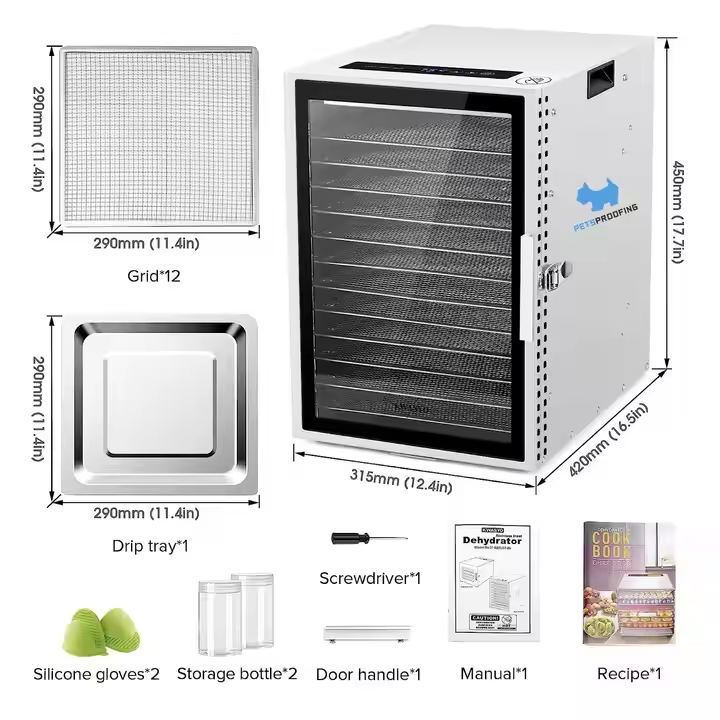
The fundamental physics of moisture removal rely on the continuous replacement of saturated air with dry, heated air. Vertical airflow dynamics often fail in commercial applications because the air must travel through multiple layers of product. As air moves vertically from the bottom heat source to the top exhaust, it picks up moisture. By the time it reaches the upper trays, the air is highly saturated and cooler, resulting in significantly slower drying times for the top layers. Vertical airflow can also cause flavor and fat dripping from upper trays to contaminate the products below.
Horizontal, pressurized airflow solves these issues by ensuring every square inch of the drying chamber receives identical Cubic Feet per Minute (CFM) of air velocity. In a horizontal system, fans push air across the trays parallel to the product surface. This laminar flow prevents the air from becoming overly saturated before it exits the tray area. Pressurized plenums behind the fans distribute the air evenly from the top to the bottom of the cabinet, guaranteeing that the front, back, middle, and sides of every tray dry at the exact same rate.
Airflow Characteristic | Vertical Airflow Systems | Horizontal Airflow Systems |
|---|---|---|
Moisture Distribution | Uneven; bottom trays dry faster than top trays. | Uniform; all trays dry simultaneously. |
Cross-Contamination Risk | High; drippings fall onto lower trays. | Low; air moves across, not through, the vertical stack. |
CFM Consistency | Decreases as air passes through dense product layers. | Maintained via pressurized rear plenums. |
Batch Scalability | Poor; adding trays exacerbates uneven drying. | Excellent; aerodynamic baffling supports high capacity. |
Tray spacing, perforation design, and aerodynamic baffling heavily impact air velocity inside a multi tray food dehydrator. If trays are spaced too closely, the static pressure increases, choking the fan motors and reducing airflow. The perforations in the trays must allow adequate air circulation around the bottom of the meat slices without letting smaller pieces fall through. Aerodynamic baffling directs the air precisely between the trays rather than allowing it to escape through the path of least resistance around the edges of the cabinet.
Larger units require independent heat zones to prevent temperature drops when fully loaded with cold, wet raw meat. When hundreds of pounds of raw pet food enter the chamber, the thermal mass of the cold product immediately absorbs the ambient heat. Without independent heating elements distributed throughout the airflow path, the system struggles to recover its target temperature quickly. This delayed recovery extends the total drying time and can leave the product in the danger zone for bacterial growth for too long.
Precision temperature and humidity sensors are non-negotiable for commercial pet food production. Standard residential sensors drift out of calibration quickly under continuous high-heat loads. Commercial-grade Resistance Temperature Detector (RTD) probes provide highly accurate, stable readings over thousands of hours of operation. These probes must be strategically placed throughout the drying chamber to monitor both the supply air entering the trays and the return air exiting the product zone. The delta between these two temperatures tells the system exactly how much moisture is actively evaporating.
Active exhaust systems rely on these real-time internal humidity readings to function correctly. When the initial moisture flashes off the raw meat, the internal humidity spikes. If this saturated air is not vented, the drying process stalls, effectively steaming the meat rather than dehydrating it. Automated exhaust dampers open to vent the wet air and close to retain heat once the internal humidity drops, optimizing both drying speed and energy efficiency.
The shift from manual dials to Programmable Logic Controllers (PLCs) marks the difference between guesswork and standardized production. Manual dials require operators to remember to adjust temperatures at specific intervals. PLCs allow facilities to program complex, multi-stage recipes. A standard pet jerky recipe requires a high initial heat stage to achieve the lethality step. This raises the internal temperature of the meat to 160°F or 165°F to kill pathogens. Once lethality is achieved, the PLC automatically drops the temperature to a lower setting for the prolonged moisture extraction phase, preventing the product from burning or case hardening.
Thermal mass and sanitation requirements make a stainless steel food dehydrator the definitive industry standard. Double-wall insulated stainless steel cabinets retain internal heat efficiently. This insulation prevents ambient temperature changes in the processing facility from affecting the internal drying environment. If a facility's loading dock doors open in winter, an uninsulated dehydrator will struggle to maintain its set point, altering the batch time. Insulated stainless steel eliminates this variable entirely.
Sanitation protocols in pet food facilities require aggressive washdowns using caustic chemicals and high-pressure water. 304 and 316-grade stainless steel provide non-porous surfaces that withstand these harsh cleaning regimens without corroding or pitting. Plastic or galvanized components degrade over time, creating microscopic crevices where salmonella or listeria can harbor and cross-contaminate subsequent batches. Fully welded stainless steel interiors with coved corners allow water to drain instantly, ensuring the equipment meets all food safety inspection criteria.
When evaluating the control systems of a new unit, verify it includes the following capabilities:
Multi-stage ramp and soak programming.
Automated exhaust damper control based on relative humidity.
Data logging export via USB or Ethernet for HACCP compliance.
Password-protected recipe banks to prevent unauthorized operator adjustments.
Visual and audible alarms for temperature deviations.
Variable Frequency Drive (VFD) compatibility for fan speed adjustments.
Integration capabilities with external facility alarm systems.
Scaling up production volume introduces complex engineering trade-offs. The most common mistake facilities make is increasing tray capacity without proportionally upgrading airflow velocity. If you double the internal volume of the cabinet and double the number of trays, you must also increase the fan motor horsepower and redesign the plenum. Pushing air across a 4-foot tray requires significantly more static pressure capability than pushing air across a 2-foot tray. Failing to balance capacity with airflow results in dead zones where product remains wet while the rest of the batch finishes.
Energy consumption versus drying speed represents another evaluation metric. Total-exhaust systems continuously pull in ambient air, heat it, pass it over the product once, and exhaust it outside. These systems dry product extremely fast because they constantly introduce dry air, but they consume massive amounts of kilowatts to continuously heat cold intake air. Insulated, recirculating units capture and reuse a percentage of the heated air, venting only the most saturated portions. While recirculating units may extend the drying cycle slightly, their energy efficiency is vastly superior for continuous, daily operations.
Facility footprint versus throughput dictates whether a facility should invest in multiple batch cabinets or a continuous tunnel dryer. Batch dehydrators offer incredible flexibility. A facility can dry beef liver in one cabinet at 150°F while drying sweet potato treats in another at 130°F. Batch systems also isolate risk; if one machine requires maintenance, the rest of the production floor keeps running. Continuous tunnel dryers, where product moves slowly through a heated conveyor system, offer massive throughput for single-product operations but require massive floor space and lack the flexibility to switch quickly between different product recipes.
Selecting the right commercial food dehydrator requires mapping these trade-offs against the facility's specific product mix and utility constraints. High-amperage electrical requirements or the need for natural gas hookups will dictate installation costs. Facilities must calculate the pounds of water they need to evaporate per hour and match that requirement against the machine's stated moisture extraction rate, rather than just looking at the total square footage of the trays.
Even the most advanced drying equipment cannot completely overcome extreme environmental factors within the processing facility. Ambient temperature and humidity swings directly affect the intake air quality. If a facility operates in a highly humid climate and lacks climate control, the dehydrator pulls in moisture-laden air, drastically extending the time required to reach the target Aw. To mitigate this risk, facilities must integrate dedicated HVAC systems and dehumidifiers into their processing rooms. Controlling the ambient environment ensures the dehydrator operates under identical baseline conditions year-round.
Operator error remains a significant risk factor for batch inconsistency. Inconsistent tray loading completely alters the airflow dynamics inside the cabinet. If operators slice meat at varying thicknesses, the thinner slices will over-dry while the thicker slices remain raw in the center. Overcrowding trays prevents air from circulating around the individual pieces, creating localized high-humidity pockets. Facilities must implement strict Standard Operating Procedures (SOPs). Use automated commercial slicers to guarantee uniform thickness. Define exact weight limits per tray and train staff to leave specific gaps between pieces to maintain aerodynamic flow.
Equipment degradation over time leads to silent failures if maintenance schedules are ignored. Sensor accuracy drifts, door seals compress and leak, and fan blades accumulate microscopic debris that alters their pitch and efficiency. A leaking door seal allows pressurized air to escape into the room rather than passing over the front of the trays, causing the front rows to dry slower than the back rows. Mitigate these mechanical risks by establishing rigorous quarterly calibration routines for all internal RTD probes. Inspect and replace silicone door gaskets annually, and schedule deep cleaning of the fan plenums to maintain optimal CFM output.
Implement the following preventative maintenance schedule to ensure long-term consistency:
Daily: Inspect door latches for tight engagement and verify exhaust dampers open and close freely without obstruction.
Weekly: Remove and sanitize all internal baffling to prevent grease buildup from restricting airflow.
Monthly: Check fan motor amp draw to identify early signs of bearing wear or electrical resistance.
Quarterly: Calibrate all RTD temperature probes and relative humidity sensors using certified testing equipment.
Audit your current water activity variance across different trays in your existing setup to identify airflow dead zones.
Calculate the exact monthly financial cost of your current waste, rework labor, and energy inefficiencies to justify equipment upgrades.
Implement strict slicing and tray-loading SOPs on the production floor to eliminate operator-induced inconsistencies.
Request technical specification sheets and verifiable airflow mapping data from commercial dehydrator manufacturers.
Schedule a pilot test with a manufacturer using your facility's specific raw ingredients before committing to a purchase.
A: High ambient humidity means the dehydrator pulls in air that is already partially saturated. This limits the air's capacity to absorb moisture from the pet food, significantly extending drying times. Closed-loop or heavily insulated recirculating systems mitigate this by conditioning the internal air and relying less on the external room environment, ensuring consistent cycle times regardless of local weather.
A: Safety requires a lethality step before dehydration begins. Raw poultry treats must reach an internal temperature of 165°F, while beef and pork must reach 160°F to destroy pathogens like Salmonella and E. coli. Once lethality is achieved and held for the required duration, the dehydrator temperature is typically lowered to 130°F - 140°F to extract moisture without burning the exterior.
A: This indicates a severe airflow distribution problem. It is usually caused by poor rear plenum design failing to pressurize the air evenly, weak fan velocity that cannot push air all the way to the front doors, or compromised door seals that allow air to escape before circulating back. Upgrading to a system with stronger horizontal laminar flow corrects this.
A: Industry standards require sensor calibration at least every 6 to 12 months, depending on production volume. High-volume facilities running 24/7 operations should verify RTD probe accuracy quarterly. Regular calibration ensures the PLC is receiving accurate data, preventing the system from under-heating the lethality step or over-drying the final product.
A: Direct in-line Aw testing inside a running dehydrator is not currently viable due to the required equilibrium conditions for Aw meters. However, advanced dehydrators use internal humidity sensors and programmed weight-loss algorithms as highly accurate proxy triggers. Once the exhaust humidity drops to a specific programmed set-point, the PLC automatically shuts down the heating elements.


