
Please Choose Your Language
Views: 0 Author: Site Editor Publish Time: 2026-09-04 Origin: Site


The drying phase dictates the success of the entire grooming process. It consumes the most time and carries the highest risk of structural coat damage, skin irritation, and animal stress if executed poorly. Many owners attempt to use human hair dryers, fundamentally misunderstanding canine coat biology. Human tools rely on thermal evaporation, utilizing dangerous heat that damages thin animal skin. Professional equipment utilizes mechanical force to physically displace water from the hair shaft. Applying the wrong airflow technique to a specific coat type guarantees severe matting, structural breakage, or thermal injury. Establishing a technical evaluation framework is mandatory. You must match specific equipment technologies—ranging from high-velocity units to enclosed automatic systems—with distinct canine coat biologies to ensure safety, efficiency, and optimal dermatological health.
Airflow Over Heat: Effective pet drying prioritizes Cubic Feet per Minute (CFM) and Feet per Minute (FPM) to mechanically displace water, rather than evaporating it with heat.
Coat-Specific Tooling: Double coats require high-velocity force to clear undercoat shedding and straighten the hair, while drop or silky coats require directional, lower-velocity air to prevent mechanical damage and tangling.
Technology Diversification: No single dryer type is optimal for every scenario; evaluating a high velocity pet dryer versus an automatic pet hair dryer depends on the pet's temperament, coat length, and the user's scalability needs (home vs. salon).
Risk Mitigation: Proper nozzle selection, working in small sections, and distance management are critical to preventing "whip knots" and protecting sensitive areas like eyes and ears.
FPM measures velocity. It provides the blunt force necessary to blast water droplets off individual hair shafts. High FPM separates dense undercoats and physically straightens curly hair during the drying process. When you direct a high-velocity nozzle at a wet coat, you should see the water physically sheeting off the hair and atomizing into a fine mist. CFM measures volume. It dictates how much air moves over the surface area, determining the overall speed of moisture removal. A high-quality Pet Dryer balances both metrics. High velocity strips the bulk water rapidly from the skin level outward. High volume ensures the coat dries completely without relying on high-wattage heating elements. Evaluating equipment requires looking at both numbers to understand the machine's true drying capability. If a machine has high CFM but low FPM, it acts like a strong fan, taking far too long to push water out of a dense coat. Conversely, high FPM with low CFM clears a small spot quickly but fails to dry the entire dog efficiently.
Canine epidermis is significantly thinner than human skin. Dogs lack sweat glands across most of their body, making them highly susceptible to thermal injury and systemic overheating. Human hair dryers use direct thermal coils to evaporate water. This method scorches dog skin and destroys the keratin structure of the hair shaft. When you apply direct heat to a wet canine coat, the water trapped against the skin reaches scalding temperatures before it evaporates. Dedicated animal drying equipment relies on ambient air or air slightly warmed by the natural friction of the motor. This mechanical approach protects the skin barrier while effectively removing moisture through physical displacement rather than evaporation. You can safely hold your hand in front of a professional unit's airflow for minutes without discomfort. Doing the same with a human dryer on high heat burns your skin within seconds.
Allowing thick or double-coated dogs to air dry presents severe dermatological risks. Wet hair clumps together, blocking ambient airflow to the skin. This trapped moisture creates an ideal, warm microenvironment for bacteria and yeast proliferation. The resulting condition, acute moist dermatitis (commonly known as hot spots), causes painful, inflamed lesions requiring immediate veterinary intervention. Furthermore, as wet undercoat dries naturally, it compacts and forms dense mats close to the skin. These mats pull on the epidermis and make future grooming nearly impossible without complete shaving. Air drying also leaves the coat with a distinct, unpleasant odor caused by the rapid multiplication of surface bacteria in the damp environment. Professional groomers never allow a dog to air dry for these exact reasons.
Concentrated, high-speed airflow mechanically shears water off the coat. The primary function of a high velocity pet dryer is rapid bulk water removal and active de-shedding. The intense force penetrates dense double coats, lifting the coarse guard hairs to access the skin level. This action physically blows out loose, dead undercoat hair. The continuous high-pressure airflow actively fluffs and straightens the remaining coat, providing a pristine, professional finish that cannot be achieved through brushing alone. When operating these units, you start at the rear of the animal and work forward, pushing the water in a single direction. The sheer mechanical force cuts drying time by up to seventy percent compared to traditional methods.
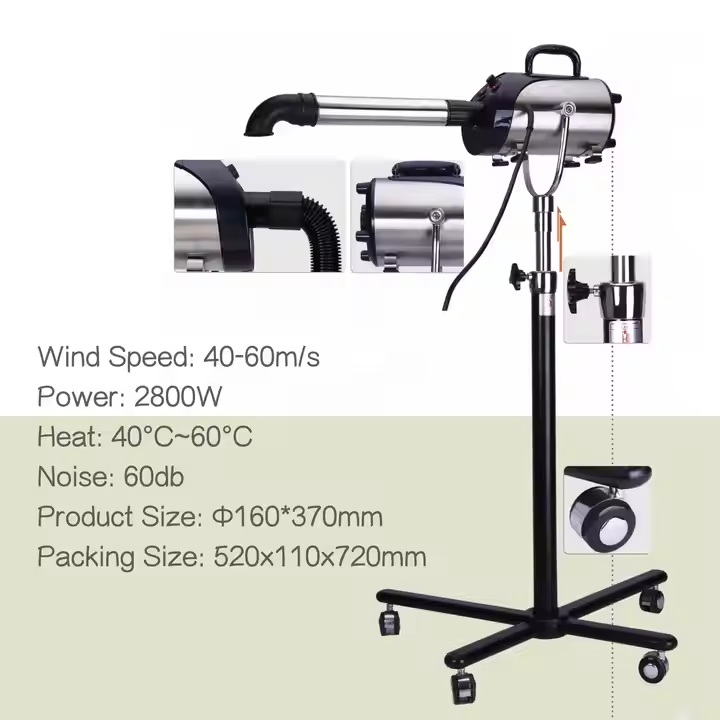
These units deliver higher heat and lower velocity compared to force dryers. A handheld pet hair dryer or stand dryer facilitates active hand-fluffing. Stand models allow for hands-free "stretch drying." The groomer uses a slicker brush to pull the hair straight while the warm air sets the style. This equipment excels at straightening curly coats and finishing delicate areas like the face, ears, and paws. Applying high-velocity force to these sensitive zones causes unnecessary distress and potential hair breakage. Stand dryers feature articulated arms, allowing you to position the nozzle exactly where you need it while keeping both hands on the dog and the brush. This setup is non-negotiable for achieving a flawless scissor finish on breeds like Poodles and Bichon Frises.
Cabin dryers provide an enclosed environment that circulates warm air evenly around the animal. A pet drying box offers a passive, hands-free alternative to active hand-fluff drying. This solution scales exceptionally well for high-volume environments, allowing operators to multitask. An automatic pet hair dryer is ideal for short-coated breeds and highly anxious animals. Pets that cannot tolerate the noise or physical force of a velocity blaster often relax in cabin dryers, provided they are properly acclimated to the enclosure. Modern cabin units feature advanced climate control, monitoring internal temperatures and humidity levels to prevent overheating. You simply place the towel-dried dog inside, set the timer and temperature, and monitor them through the clear viewing door while you prep the next animal.
The optimal solution requires high-velocity force. Airflow must penetrate the coarse guard hairs to reach the dense undercoat layer. Directing the nozzle close to the skin blows out loose, dead undercoat hair, effectively de-shedding the animal while drying. You will physically see the dead undercoat flying out of the main coat like a snowstorm. This process leaves the coat visibly fluffy and straight, preventing undercoat impaction. Using low-velocity heat or allowing passive air drying on a Husky or Golden Retriever traps moisture against the skin. This guarantees hot spots and a severely compacted undercoat that will require professional dematting. When working on a heavily coated breed, you must work systematically in small sections. Hold the nozzle parallel to the skin and push the water and dead hair outward. Never use a circular motion, as this instantly mats the undercoat into a solid pelt.
Poodles and Bichons require a hybrid approach. Begin with high-velocity force for rapid bulk water removal across the torso and legs. Do not use a concentrator nozzle during this phase; the raw hose provides enough force without tangling the curls. Follow immediately with a stand dryer or handheld unit for the finishing phase. This coat type demands strict "stretch drying." You must use a slicker brush simultaneously with directional, lower-velocity air to stretch the hair shaft straight. You pull the hair up and away from the skin, letting the warm air lock the hair into a straight position. Failing to stretch dry curly coats results in tight ringlets. These ringlets rapidly form severe mats close to the skin as the dog moves. A properly stretch-dried Poodle coat looks like a plush velvet blanket, ready for precision scissoring.
Yorkshire Terriers and Afghan Hounds possess delicate hair structures resembling human hair. The optimal tool is a stand dryer or variable-speed handheld unit. Air must flow strictly downward, following the exact direction of hair growth. Forcing high-velocity air in multiple directions through fine, silky coats causes immediate, severe tangling known as "whip knots." These microscopic knots often require cutting to remove, completely ruining the coat's structural integrity and length. You must pin the wet hair flat against the dog's body with the airflow. Use a pin brush to gently separate the strands while the air pushes the moisture down and off the tips of the hair. Never blast a drop coat from the bottom up.
Pugs, Boxers, and French Bulldogs require minimal mechanical force. The optimal approach involves thorough towel drying combined with a low-velocity handheld unit or an automatic cabin enclosure. The primary focus remains gentle moisture removal while maintaining optimal skin health. Over-drying smooth coats with high heat strips natural dermal oils. This leads to dry, flaky skin, excessive shedding, and a dull, unhealthy coat appearance. You can use a rubber curry brush during the drying process to massage the skin and remove loose shedding hair. Keep the nozzle at least six inches away from the skin and keep it moving constantly. Smooth coats dry rapidly, so monitor the skin closely to ensure you stop the process as soon as the moisture is gone.
Rheostat dials offer continuous, variable control over airflow, whereas standard toggle switches restrict users to fixed low and high settings. Variable control proves mandatory when transitioning across different anatomical zones. You need maximum speed to blast water from a thick torso but must instantly dial down the velocity when moving toward the sensitive face, ears, or sanitary areas. Precision airflow control prevents acoustic trauma, physical discomfort, and accidental injury to delicate tissues. When a dog shows signs of panic, you can immediately roll the dial back to a whisper-quiet setting. This level of control builds trust with the animal and prevents grooming-induced trauma. Fixed-speed machines force you to pull the nozzle further away to reduce pressure, which is highly inefficient and wastes time.
Nozzle shape fundamentally alters fluid dynamics and drying efficiency. Selecting the wrong attachment extends drying time and damages the coat. You must swap nozzles based on the specific task at hand.
Nozzle Type | Airflow Characteristic | Primary Application |
|---|---|---|
Cone Nozzle | Compresses air for maximum velocity and pinpoint accuracy. | Penetrating thick mats, blowing out dense undercoat, and active de-shedding. |
Flat Nozzle | Spreads airflow into a wide, horizontal band. | "Squeegee" effect to push bulk water off flat coats and broad body panels. |
Water Sweep / Rake | Combines physical tines with wide airflow distribution. | Separating long hair while simultaneously pushing water down the hair shaft. |
Open Hose (No Nozzle) | Maximum volume (CFM) with reduced velocity (FPM). | Fluffing curly coats without causing tangles; drying sensitive areas safely. |
High-velocity motors generate significant decibel levels, triggering severe acoustic stress in sensitive animals. Evaluating acoustic dampening features is critical for a safe grooming environment. Dual-housing motors insulate internal components, significantly reducing external noise. Extra-long, flexible hoses allow operators to place the primary motor unit in an adjacent room, isolating the noise source from the grooming table. Variable speed dials further manage acoustic stress by allowing gradual increases in sound volume, giving the animal time to adjust. You should also consider the pitch of the motor. Some cheaper units produce a high-frequency whine that is physically painful to a dog's sensitive hearing. High-quality units produce a lower, deeper rumble that most dogs tolerate easily.
Home users and professional salons evaluate equipment ROI through different lenses. For home grooming, investing in proper equipment eliminates expensive veterinary bills associated with hot spots and prevents costly salon dematting fees. It turns a frustrating, hours-long chore into a manageable task. For professionals, the metric is pure throughput. Shaving five minutes off the drying time per dog allows a salon to process an additional animal daily. This directly increases revenue, reduces physical fatigue on the groomer, and maximizes operational scalability. Professional units feature heavy-duty carbon brushes and impact-resistant housings designed to run continuously for eight hours a day. Home units prioritize compact storage and lighter weight over continuous-duty cycles.
Holding the nozzle too close to the skin concentrates the mechanical force dangerously. This causes bruising, skin irritation, or severe tangling in longer coats. Maintain a distance of two to four inches to allow the air to spread efficiently. Always angle the nozzle slightly downward. Blasting air at a direct 90-degree angle into the skin drives moisture deeper into the undercoat and creates unnecessary friction tangles. You want the air to act like a wedge, sliding under the water droplets and lifting them off the skin. Move the nozzle in slow, deliberate lines. Rapid, erratic movements confuse the dog and fail to push the water off the coat systematically.
High-velocity air directed into the ear canal causes immediate trauma, disorientation, and potential hearing damage. Directing force at the eyes risks severe corneal abrasions from flying debris or water droplets. Always utilize physical barriers, such as grooming hoods or your hand, to shield the eyes and ears. Reduce airflow to the lowest possible setting when working near the head, and rely on ambient warm air rather than mechanical force. You can place cotton balls gently in the ear canals to muffle the sound and block stray water droplets. When drying the face, remove the concentrator nozzle entirely and hold the hose at least twelve inches away, letting the diffused air gently dry the muzzle and cheeks.
Whip knots occur when high-velocity air forces long hair strands to whip around and tie themselves into microscopic, unbreakable knots. Mitigate this risk by removing the concentrator nozzle entirely when drying long drop coats. This diffuses the air pressure. Always direct the airflow strictly downward, parallel to the hair shaft. Never blow against the grain or move the nozzle in a circular motion, as this guarantees severe structural coat damage. If you see the hair starting to spin or twist in the airstream, immediately pull the nozzle back and adjust your angle. Use a heavy, leave-in conditioning spray before drying to add weight to the hair shaft, which helps keep the strands lying flat against the body.
Identify the specific coat type of the dog on your table before selecting your equipment and nozzle attachments.
Test the airflow velocity on your own arm to gauge the mechanical force before directing the nozzle at the animal.
Apply a physical barrier, such as a fabric grooming hood, over the dog's ears to block high-velocity air and muffle motor noise.
Remove the concentrator nozzle and switch to a downward airflow angle when drying long, silky coats to prevent whip knots.
Dial down the variable speed control to its lowest setting immediately when transitioning from the torso to the face or sanitary areas.
A: No. Human hair dryers rely on high heat to evaporate moisture. This intense heat easily burns a dog's thin skin and causes systemic overheating. Professional pet equipment uses mechanical force and ambient air to blow water off the coat safely without thermal damage.
A: Air drying allows wet hair to clump together. As the undercoat dries naturally, the hair shrinks and compacts, forming dense mats near the skin. Mechanical drying straightens the hair shaft and separates the coat, completely preventing these tight tangles from forming.
A: A cone nozzle is optimal for double coats. It compresses the airflow, maximizing the velocity needed to penetrate coarse guard hairs. This concentrated force effectively blows out the dense, shedding undercoat from the skin level outward.
A: Use a physical barrier like a fabric grooming hood to cover the ears. Always dial the machine down to its lowest speed setting when working near the head. Never point the nozzle directly into the ear canal, as this causes severe acoustic trauma.
A: Drying boxes are highly effective for short-coated breeds and acclimated pets. However, you should never use them for brachycephalic breeds like Pugs or Bulldogs without strict, constant supervision. Flat-faced breeds are highly prone to respiratory distress and overheating in enclosed environments.
A: Stretch drying is a technique used on curly coats like Poodles. You use a slicker brush to pull the hair straight while simultaneously applying warm, low-velocity air. This sets the hair shaft straight and prevents tight ringlets from forming.
A: Redness indicates the nozzle was held too close to the skin, causing friction burn or bruising from the concentrated air pressure. Always maintain a distance of two to four inches and keep the nozzle moving constantly to prevent localized trauma.


