
Please Choose Your Language
Views: 0 Author: Site Editor Publish Time: 2026-08-12 Origin: Site


Purchasing a heavy-duty stainless steel kennel is a significant investment. Guessing the dimensions often leads to costly return shipping, compromised structural integrity, or severe canine anxiety. Unlike standard wire crates, stainless steel units are rigid, heavy, and unforgiving. An improperly sized cage risks the dog's physical safety, causing joint stress and paw injuries. It also defeats the behavioral purpose of den-like containment. When an enclosure fails to match the physical and psychological needs of the animal, it becomes a hazard rather than a safe haven.
This guide provides an evidence-based framework for measuring your dog accurately, evaluating steel gauge specifications, and selecting the correct configuration. Whether you are outfitting a residential space, a commercial boarding facility, or a clinical environment, understanding the exact spatial requirements ensures long-term safety and functionality. You will learn how to calculate internal dimensions, assess structural load capacities, and avoid common implementation mistakes that compromise containment security.
Precision Measurement: Calculate internal kennel dimensions by measuring the dog’s length, height, and width, adding exactly 4 inches to each to allow for unhindered turnaround space without losing den security.
Match Grade to Use Case: Differentiate between standard home enclosures, a high-visibility display pet cage, and a clinical veterinary pet cage based on the dog's bite force and the facility's sanitation requirements.
Prioritize Modularity: Long-term hygiene and maintenance require specific structural features, such as a heavy-duty removable pet cage tray and appropriately spaced floor grates.
Verify Implementation Logistics: Factor in the physical footprint, doorway clearance for pre-welded units, and floor weight-bearing limits before finalizing a purchase.
The primary function of any containment system is to provide a secure, comfortable environment that mimics a natural den. Failing to size the unit correctly introduces immediate physical and behavioral risks. An undersized enclosure forces the dog into unnatural resting postures. Over time, this constant compression leads to severe orthopedic stress, particularly in the hips and spine of large breeds. Dogs regulate their body temperature through panting and spatial positioning. In a cramped space, they lose the ability to thermoregulate effectively because they cannot move away from areas warmed by their own body heat. They are also forced into close contact with any accidental waste, creating immediate hygiene and dermatological issues.
Conversely, oversizing presents its own set of behavioral challenges. Excess space eliminates the natural den instinct. A dog relies on the close boundaries of their enclosure to feel protected from external threats. When a kennel is too large, the dog no longer perceives it as a single resting space. Instead, they will often designate one corner for sleeping and another for elimination. This completely undermines house training efforts. The excess room also encourages pacing behavior, which drastically increases anxiety levels and often leads to destructive chewing or frantic attempts to escape.
Beyond the dog's well-being, sizing errors carry heavy logistical penalties. A heavy-duty kennel requires a substantial footprint. Unlike thin wire crates, steel enclosures feature thick tubular framing that adds several inches to the external dimensions. Placing an oversized unit in a standard residential hallway or living room can disrupt traffic flow and block access to essential areas. In commercial settings, inefficient sizing reduces the total number of units you can safely install, directly impacting operational capacity.
Stainless steel kennels are shipped via freight, often arriving on wooden pallets. If you order the wrong size, return shipping costs are exorbitant. Repackaging a 150-pound welded steel cage is a massive physical undertaking. Getting the measurements right the first time is a strict financial necessity. You must account for the exterior dimensions of the frame, the swing radius of the door, and the clearance required to slide out the waste tray.
Accurate sizing begins with capturing your dog's exact physical dimensions using a flexible measuring tape. Never estimate these numbers. Follow these specific steps to get the right numbers:
Measure the length from the tip of the dog's nose to the base of the tail. Explicitly exclude the full tail length to prevent oversizing. Including a long tail in your calculation will result in a kennel that is far too deep, encouraging the dog to soil the back end of the enclosure.
Determine the required height by measuring from the floor to the top of the head while the dog is in a standard sitting position. For erect-eared breeds like German Shepherds or Belgian Malinois, measure to the very tips of the ears. A dog must be able to sit completely upright without their ears or head scraping the top panel.
Measure the shoulder width. Dogs sleep in various positions, often sprawling on their sides. Capturing the widest point of their body ensures they have the necessary lateral clearance to adjust their posture comfortably.
Once you have the baseline measurements, apply the industry-standard formula to calculate the required internal dimensions of the pet cage. The formula dictates:
Minimum Kennel Length = Dog Length + 4 inches
Minimum Kennel Height = Dog Height + 4 inches
Minimum Kennel Width = Dog Shoulder Width + 4 inches
This formula guarantees enough room for the dog to stand up, turn around completely, and lie back down without restriction. However, you must account for specific needs and breed anomalies. Thick-coated breeds like Huskies or Malamutes benefit from up to 6 inches of extra clearance for better airflow to dissipate heat. Senior dogs suffering from arthritis often require thick orthopedic bedding. This bedding can reduce the internal vertical height by up to 4 inches, meaning you must increase the kennel height accordingly to maintain adequate headroom.
Long-bodied breeds present sizing exceptions where length dictates a much larger footprint than weight suggests. Dachshunds, Corgis, and Basset Hounds require extended length dimensions, even if their height and weight align with smaller enclosures. Giant breeds like Great Danes may require custom vertical clearances that exceed standard manufacturing templates. Always measure the specific dog rather than relying on breed averages.
Dimensions alone do not guarantee a secure containment system. Weight ratings are a critical sizing metric for a heavy-duty enclosure, unlike lightweight wire alternatives. A large dog exerts massive localized pressure on the floor grates and door hinges. If the steel is too thin, the floor will bow, creating an unstable surface that causes joint pain and anxiety.
Do not rely solely on generic breed or weight-based sizing charts provided by manufacturers. Physical measurements must always dictate the final size. A chart might suggest a 42-inch kennel for a Labrador, but a particularly tall or long Labrador will require a 48-inch unit. Mapping dog weight classes to required steel thickness prevents floor warping or weld snapping under heavy loads.
Dog Weight Class | Recommended Steel Gauge | Structural Considerations |
|---|---|---|
Under 50 lbs | 20-Gauge or 22-Gauge | Standard tubular framing is sufficient. Floor grates need standard cross-bracing. |
50 lbs to 90 lbs | 18-Gauge | Requires reinforced hinges and thicker floor grates to prevent bowing under localized paw pressure. |
Over 90 lbs (or aggressive chewers) | 16-Gauge to 18-Gauge | Mandatory heavy-duty slam latches, reinforced corner welds, and thick-gauge wire mesh or solid bars. |
When integrating a containment system into a home, the requirements differ vastly from a clinical setting. Standard residential heavy-duty units are best suited for high-anxiety, destructive, or escape-artist dogs. These dogs easily destroy plastic airline crates or bend the thin wires of standard folding cages. A robust stainless steel dog kennel provides the impenetrable boundaries required to keep both the dog and the home safe during unsupervised hours.
An indoor heavy-duty enclosure meant for den-like resting differs from larger indoor/outdoor kennel runs designed for extended movement. An indoor resting kennel should strictly follow the "+4 inches" rule. A kennel run is designed for hours of activity and elimination, requiring vastly larger dimensions. Residential buyers must often compromise slightly on aesthetics to achieve the necessary weld strength required for a powerful working breed. Look for 304-grade stainless steel if the unit will be exposed to moisture, as it offers superior rust resistance compared to 430-grade steel.
Clinical environments demand specialized containment solutions focused heavily on sanitation and medical access. A veterinary pet cage is typically built into a modular bank, allowing clinics to stack multiple units securely. These systems must feature seamless interior welds to prevent bacteria buildup and allow for rapid chemical disinfection between patients. They also require specific structural additions like IV drip integration and oxygen therapy doors.
Following orthopedic surgery, a dog must be restricted from turning rapidly or pacing. In these specific medical scenarios, veterinarians intentionally utilize a smaller enclosure that provides only enough room to stand and lie down. This temporarily ignores the standard "+4 inches" rule to prevent the animal from tearing sutures or re-injuring a repaired joint. The floor grates in these units are often coated or replaced with solid orthopedic mats to provide stable footing during recovery.
Animal shelters, adoption centers, and premium retail environments prioritize visibility alongside security. A display pet cage removes the visual barrier of heavy steel bars, allowing potential adopters or buyers to interact with the animal more naturally. The glass must be tempered, shatterproof, and sealed to prevent fluids from leaking into the display track.
Display enclosures are often utilized for shorter durations during operating hours. While they must still accommodate the dog comfortably, they do not always require the expansive dimensions of a permanent residential den, provided the animal is rotated into larger exercise areas frequently. Ventilation is a critical factor here. Solid glass fronts restrict airflow, so the unit must feature heavily ventilated side panels or an active exhaust system to maintain a safe internal temperature.
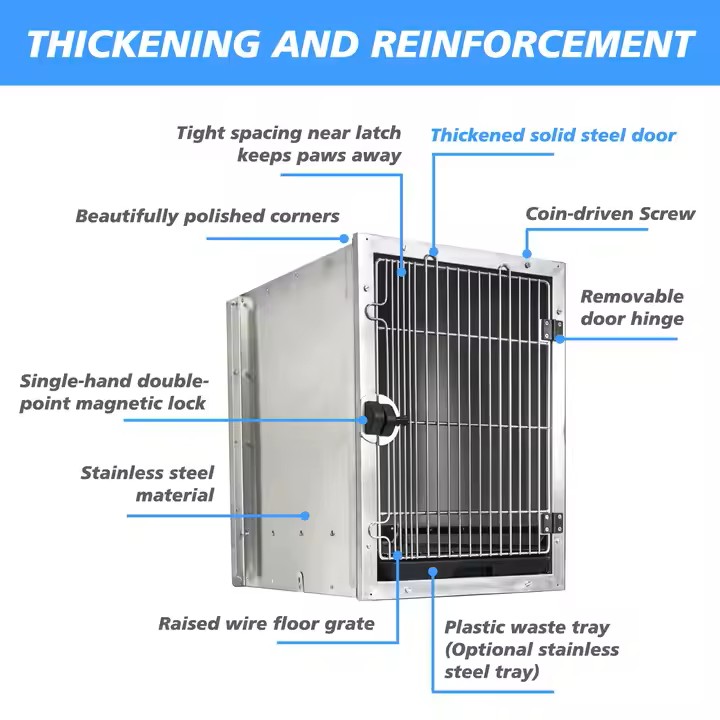
Long-term maintenance of a heavy steel enclosure relies entirely on its modular components. A properly designed removable pet cage system allows owners or facility managers to extract the waste tray without opening the main door or removing the dog. This feature is critical for aggressive dogs or clinical settings where handling must be minimized.
Avoid flimsy plastic trays in large metal kennels. Use stainless steel or high-density composite trays that will not warp under heavy dogs. When a 100-pound dog shifts its weight, a thin plastic tray positioned beneath a floor grate can crack, leading to leaks that damage residential flooring or create biohazards in commercial facilities. A 304-grade stainless steel tray is the industry standard for durability and sanitation, as it withstands harsh enzymatic cleaners without degrading.
The door is the primary failure point of any containment system. A unit with both a front and a side door allows you to position the kennel in corners or narrow hallways without blocking access. This spatial flexibility is highly valuable in smaller homes or crowded veterinary wards.
Slide bolts are common but can be rattled open by persistent dogs using their paws or snouts. A heavy-duty slam latch automatically engages when the door is pushed closed, providing a much higher level of security against escape artists. Ensure all locking mechanisms are shielded or positioned out of the dog's direct reach. Spring-loaded latches offer an additional layer of security, requiring human dexterity to disengage.
Stainless steel units are exceptionally heavy, often exceeding 100 pounds for large breed sizes. Heavy-duty, locking, non-marring casters are required to safely move these units for room cleaning. Without casters, cleaning behind or beneath the kennel becomes a physical impossibility, leading to dust and dander accumulation. The casters must feature dual-locking mechanisms that secure both the wheel roll and the swivel to keep the kennel completely stationary when the dog moves inside. Polyurethane wheels are preferred over hard plastic, as they absorb vibration and will not scratch hardwood floors.
The gaps in the floor grate should generally not exceed 0.5 to 0.75 inches for adult dogs. If the gaps are too wide, the dog's toes can slip through, resulting in severe panic and potential fractures when they attempt to stand up quickly. The grate wire itself should be thick enough to provide a comfortable resting surface without cutting into the dog's paw pads.
Purchasing a premium steel enclosure for a growing puppy presents a sizing dilemma. You should purchase the kennel based on the dog's projected adult size. Then, insert a steel divider panel to reduce the internal space, maintaining the "Plus 4 Inches" rule at every stage of development. If you give a puppy access to the full adult-sized footprint, they will inevitably use the far end as a bathroom.
While the upfront cost of a steel unit with a divider is higher, it eliminates the need to purchase, discard, and replace three or four wire crates as the dog matures. This approach ultimately saves money and reduces waste over the dog's growth cycle. Ensure the divider panel locks securely into the frame so an active puppy cannot push it out of place.
Before ordering, you must audit the physical path from your delivery point to the final installation room. Measure home and clinic doorways and hallways carefully. Standard interior residential doors are often only 30 or 32 inches wide. A pre-welded 48-inch kennel offers superior structural integrity but will not fit through these frames. If you have narrow hallways or tight corners, you must select a flat-pack model that can be assembled directly in the designated room.
Place conductive metal kennels away from direct sunlight or HVAC vents to prevent extreme temperature fluctuations inside the cage. Stainless steel absorbs and retains heat rapidly. Placing the unit near a sunlit window can turn the enclosure into an oven during summer months. Positioning it directly under an air conditioning vent can cause the metal to become uncomfortably cold, forcing the dog to avoid the space entirely.
Sizing a stainless steel kennel requires strict adherence to the Length/Height/Width + 4" rule, combined with an honest assessment of the dog's weight and behavioral tendencies. Guesswork leads to compromised safety, structural failure, and wasted financial resources. By prioritizing internal dimensions first, steel gauge and weld quality second, and maintenance features third, you ensure a secure, lifelong containment solution for your animal.
To finalize your selection, follow these immediate next steps:
Measure your dog twice using a flexible tape measure while they are standing and sitting squarely, recording the exact numbers before looking at any product catalogs.
Verify your facility's doorway clearances and hallway turning radiuses to ensure a large, heavy-duty unit can physically reach its designated room.
Cross-reference manufacturer breed charts with your actual measurements, ignoring generic weight recommendations if they conflict with your dog's physical length or height.
Request technical specification sheets from the manufacturer to confirm the internal dimensions, ensuring the steel framing has not inflated the usable space metrics.
A: Yes. If a kennel is too large, it eliminates the dog's natural den instinct. The excess space often encourages the dog to use one side for sleeping and the other for elimination, which ruins house training. It can also induce anxiety and pacing behaviors in dogs that prefer tight, secure boundaries.
A: Veterinary cages are designed for clinical environments, featuring modular bank configurations, seamless interior welds for rapid chemical sanitation, and attachments for medical equipment like IV drips. Home kennels prioritize den-like comfort, aesthetic integration into residential spaces, and heavy-duty containment for high-anxiety dogs.
A: Measure the length from the tip of the nose to the base of the tail, excluding the full tail. Measure the height from the floor to the top of the head or ear tips while sitting. Measure the width across the broadest part of the shoulders. Add exactly 4 inches to each measurement.
A: For large breeds, escape artists, or aggressive chewers, you should look for 18-gauge stainless steel or thicker. Lower gauge numbers indicate thicker metal. 20-gauge steel is generally sufficient for smaller, calmer dogs, but it may warp or bend under the sustained force of a powerful, anxious dog.
A: A floor grate is highly recommended for maintaining hygiene, especially for puppies or dogs prone to accidents. It allows liquid and solid waste to fall through to a removable tray below, keeping the dog clean and dry. Ensure the grate spacing is narrow enough to prevent paw injuries.
A: Purchase the kennel size required for the dog's projected adult dimensions and use a heavy-duty steel divider panel. Position the panel to restrict the available space to fit the puppy's current size using the plus 4 inches rule, and gradually move the panel back as the dog grows.


